Tuesday, January 11, 2022

Postmodernism -- and Jean-Michel Basquiat's place therein

Modernism, as discussed in a prior post, "sought a new alignment with the experience and values of modern industrial life" but, by the middle of the 20th century, "modern life" had been disrupted (The Art Story):

  • The world had experienced two world wars with millions of lives lost
  • Nuclear weapons had been used 
  • Communist ideals had been shattered, partly by its own weight and partly by a re-invigorated post-war capitalism.

Societal changes had been accompanied by changes in the art world: The center of avant-garde painting had shifted from Europe to NYC and Abstract Expressionism, and its practitioners, were flourishing. 

It was at this point that the first cracks begun to appear in the modernist superstructure as young artists began to question the relevance of the art for the times as well as the perch occupied by the feted artists. Artists like Jasper Johns and Robert Rauschenberg began to experiment with new styles that borrowed and recreated imagery from the mass culture that surrounded them. This was the beginning of the neo-Dada movement -- "the first of the genuinely postmodern movements" -- which would itself give rise to other postmodern movements such as POP Art and Minimalism.

The chart immediately below captures the main postmodernist movements while the two images following show works created by Johns and Rauschenberg during the neo-Dada period.

Monogram, 1955 - 1959
Robert Rauschenberg

White Flag, 1955
Jasper Johns

If neo-Dada is the first of the postmodern movements, what exactly is postmodernism. According to MOMA, it is a reaction against modernism, "less a cohesive movement than an approach and attitude toward art, culture and society" whose main characteristics include:

  • Anti-authoritarianism
  • Collapsing of the distinction between high culture and mass or popular culture
  • Collapsing of the distinction between art and everyday life
  • A deliberate use of earlier styles and conventions
  • An eclectic mixing of different artistic and popular styles and media.
Selected pieces of postmodern art are depicted below.

Marilyn Diptych, 1962
Andy Warhol

The Physical Impossibility of Death in the Mind of Someone Living, 1991
Damien Hirst

Untitled, c. 1996
Jamali

Jean-Michel Basquiat
Jean-Michel Basquiat transitioned from the text-focused Graffiti Art to the imagery-based Neo-Expressionism movement, a movement described by Phoebe Hoban, in her book Basquiat: A Quick Killing in Art, as
...  merely a trendy fashion statement, a bleep on the radar ... The Abstract Expressionists came together to promote a cause, while the East Village artists came together to promote themselves.
Jean-Michel Basquiat
By Source, Fair use, https://en.wikipedia.org/w/index.php?curid=29602496

Basquiat was born in Brooklyn in 1960. One of the seminal events in his youth was being hit by a car in the street of his residence, necessitating a lengthy rehabilitation. During his rehab, his mother gave him a copy of the Book Gray's Anatomy which he studied assiduously. The influence of that book is apparent in much of his art.

Jean-Michel dropped out of school prior to graduation and fell into the graffiti culture which was then taking off in Brooklyn and the Bronx. He tagged with a fellow artist under the moniker Samo© but when they fell out, he killed off the designation.

New York City was falling apart at this time. It was deep in debt and awash in deserted and abandoned buildings. The cheap rent attracted artists to the Lower East Side and this mish mosh of practitioners from all branches of the arts yielded a unique, gritty culture. Basquiat fell right into this, steering away from graffiti and wanting to be considered an artist.

During this time he could not afford art supplies so he painted on anything that was available -- scraps of paper, doors from abandoned buildings, etc. His artistic skills began to be noticed but his sprint to the top really began with his participation in the January 1981 art show at PS1 in Queens that was organized by Diego Cortez. Basquiat's path to stardom post that meeting is shown in the chart below.


Untitled (Word on Wood) is one of 17 Basquiat paintings that incorporates wood fence slats. The slats are painted black and divided into two unequal hemispheres. The upper hemisphere is dominated by a blue square with a gold border which serves as a frame for an African-mask-like structure with mismatched oval eyes and bared teeth. A line runs from a distinctly negroid nose through a unibrow to the top of the forehead, dividing the forehead into two unequally adorned hemispheres. The top of the head is festooned with light-brown, cornrow-type structures.

The lower hemisphere is populated by some of the markings for which Basquiat is known. The left, chair-like structure is brown in color and associated with a white comb marking while the right leg is entwined by a green vine and is adjacent to an upturned comb.

Untitled (Word on Wood), 1985
Jean-Michel Basquiat

Yellow Door is a collage of different textured items emplaced on a bright-yellow, two-hemisphere, wooden door. The Spanish word for miracle is repeated a number of times on the structure's upper hemisphere.

Yellow Door (1960), 1985
Jean-Michel Basquiat

Selected additional Basquiat paintings are shown below.

Untitled (Self-Portrait), 1982
Oilstick and ink on paper

Untitled (Man with Microphone), 1982
Oilstick on paperboard

Per Capita, 1981
Acrylic and oilstick on canvas

Arroz con Pollo, 1981
Acrylic and oilstick on canvas

Warrior, 1982
Acrylic and oilstick on wood panel

Untitled, 1982
Acrylic, oilstick, and spray paint on wood

Untitled, 1982
Acrylic, oilstick, and spray paint on wood

Untitled, 1981
Acrylic and oilstick on canvas

Untitled (tenant), 1982
Acrylic and oilstick on canvas

Self-Portrait with Suzanne, 1982
Oilstick on paperboard

Cathleen McGuigan (New York Times, 2/10/85) provides a comprehensive description of Basquiat's paintings:
His color-drenched canvasses are peopled with primitive figures wearing menacing, masklike faces, painted against fields jammed with arrows, grids, crowns, skyscrapers, rockets and words ... His drawings and paintings are edgy and raw, yet they resonate with the knowledge of such modern masters as Dubuffet, Cy Twombly or even Jasper Johns.
Table 1. Characterizing Basquiat's talent
NameProfessionAssessment
Sandro Chia (after the PS1 show)Painter (Italian)“Basquiat’s paintings captured the spontaneity of the City”
“The paintings were full of disparate elements that somehow worked together though there was no apparent system linking them”
John RussellChief art critic, New York Times“Basquiat proceeds by disjunction — that is by making marks that seem quite unrelated, but that turn out to get on very well together”
Vivian RaynorNew York Times Writer“The educated quality of Basquiat’s line and the stateliness of his compositions both of which bespeak a formal training that, in fact, he never had.”
Data Source: Cathleen McGuigan, New Art, New Money, NYT, 2/10/85

Jean-Michel Basquiat died of an overdose in 1988. He was 28 years old.

©EverythingElse238

Wednesday, January 5, 2022

Abstract Expressionism in the Modernism canon

Modernism, according to tate.org.uk, "refers to a global movement in society and culture that from the early decades of the twentieth century sought a new alignment with the experience and values of modern industrial life. Building on late nineteenth century precedents, artists around the world used new imagery, materials and techniques to create artworks that they felt better reflected the realities and hopes of modern societies." A second source (the collector.com) is in agreement with this definition except that (i) they limit it to the western world and (ii) they see it as a complete break with everything that went before (rather than a "build").

Many different styles are encompassed by the term modernism but they all are bound by a set of underlying principles (Tate):

  • A rejection of history and conservative values
  • Innovation and experimentation with form with a tendency to abstraction
  • An emphasis on materials, techniques, and processes.

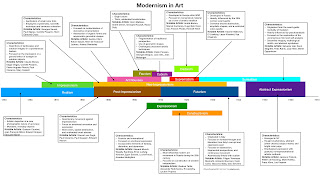
A graphical representation of the various art movements encompassed in the term modernism is provided below.


Abstract Expressionism

In the early 1940s, the East Village became the stomping grounds for a number of artists who congregated there, sharing ideas in a manner akin to the Impressionists in Montmartre. These artists shared "an interest in using abstraction to convey strong emotional or expressive content" and a "characteristic messiness and extremely energetic application of paint." These artists eschewed narrative and symbolism in their work, exploring, instead, "the literal act of applying paint to the canvas."


The figure below presents a graphical overview of the key characteristics of the movement.


Phoebe Hoban, in her book Basquiat: A Quick Killing in Art, compared the Abstract Expressionism movement to the later -- but geographically co-located -- Neo-Expressionism movement

... while the first movement shifted the tectonic plates of the art world from Paris to New York and shaped Western culture for the second half of the twentieth century, the second movement was merely a trendy fashion statement, a bleep on the radar ... The Abstract Expressionists came together to promote a cause, while the East Village artists came together to promote themselves.

According to Phoebe, the Abstract Expressionists put themselves on the map with a show on Ninth Street in 1951. Sixty-one artists displayed 61 pieces of art, the first time that the general public had had an opportunity to see the full scope of the movement's coverage. 


Action Painting

One of the Abstract Expressionist works that I find especially interesting is Franz Klines Untitled. In the figure above, which describes key influences for the Abstract Expressionists, I mentioned the role of chance in the contours of the final product. Other action painters like Willem de Kooning and Jackson Pollock were dyed-in-the-wool improvisationalists. Kline's approach, however, "was methodical and meticulously planned before execution. His paintings started as drawings, which he projected at a larger scale onto canvas."


Franz Kline
Untitled, 1960
Oil on paper


The other works that I found appealing in this section are shown below.

Hans Hoffman
Composition #3, 1956
Oil on canvas

Jean Miotte
Untitled, 1958
Oil on canvas

Willem de Kooning
Woman II, 1961
Oil on paper mounted on canvas

Helen Frankenthaler
February's Turn, 1979
Acrylic on canvas

Michael Goldberg
The Keep, 1958
Oil on canvas

Joan Mitchell
Aire pour Marion (Space for Marion), 1975-76
Oil on canvas

Mark Rothko
Untitled, 1968
Oil on paper mounted on canvas

Theodoros Stamos
Sentinel, 1962-64
Oil on canvas

Expressionism and Repetition
Wherein the artists in the prior section reveled in spontaneity, chance, and improvisation, the artists spotlighted in this section were focused on symmetry and bounding colors within geometric shapes. The work by Richard Anuszkiewicz has a somewhat hypnotic look to it, with the green distinctly separated from the red. On closer examination one can be sucked into the myriad, connector-like lines that constitute that outer red layer. A truly complex construct.

Josef Albers
Study for Homage to the Square, 1964
Oil on blotting paper

Richard Anuszkiewicz
Temple to Royal Green, 1983
Acrylic on canvas

Frank Stella
New Caledonian Lorikeet, 1980
Mixed media on Tycore Board

Kenneth Noland
Summer's Gold, 1983
Acrylic on canvas

©EverythingElse238

Thursday, December 16, 2021

The Romans and Wine: Taking a good thing and making it better

The Romans possessed an exceptional capacity for taking "good things" and making them better and, according to Professor Elizabeth Lev, this characteristic was manifested in spades in the wine world.

The Greeks were responsible for the creation of the wine culture in Italy. They named the southern portion of the peninsula Oenetria -- "the land of the tamed vines", according to Professor Lev. They also brought some of their native varieties to Italy. Aglianico, for example, is widely held to be a Greek transplant, with the Italian name being a transformation of Hellenistico (Greece was known as Hellas).

The Romans did not get involved in serious wine drinking until about the 3rd century when they developed a bread culture. Prior to this period, the main Roman dish was a porridge-like concoction called puls, which was served during cena, the main meal of the day. Adoption of bread-based meals began in the 3rd century and with it the rise of bakeries and wine drinking.

The Greeks had historically grown their grapes along the ground or trained in trees. The Romans developed the Pergola which lifted the vine off the ground, allowing greater access to the sun for all parts of the berry as well as allowing wind to dry out the vines after rainfall.

The Greeks and Egyptians had historically trod their grapes to extract the juice. The Romans adopted this practice but also added mechanical means of pressing the juice from the grapes.

The Romans  were the first to distinguish between first and subsequent pressings with the third press set aside and, in many cases, given to the slaves.

The Romans were also the first to (Professor Lev):
  • Understand vintage differential
  • Serve wine in glassware
  • Work on wine storage (both in terms of where and length).
The Romans also preferred white wines to red with Livia Augusta attributing her long life to a daily tipple of Pucinum, a forerunner to today's Prosecco.

The most famous of the Roman wines was Falernian, a sweet, high-alcohol, late-harvested wine. According to Professor Lev, this wine was made from the Aglianico grape but another source claims that it was made from Falanghina while two others give that honor to the Aminean grape. This wine was highly prized and priced. Professor Lev spoke of the Opimian vintage of 121BC which was served at a Julius Caesar banquet in 60BC.

Wines for the masses were flavored with chalk, seawater, honey, etc. The wines served to aristocrats were first boiled-down in lead-lined pots, the process concentrating the wine by 1/3 or as much as 1/2, depending on the preference. Boiling in the lead added a specific sweetness to the wine but also poisoned the drinkers. Gout and dementia are symptoms of lead consumption, conditions manifested in many of the Roman rulers of this period.

By 50AD, Romans were consuming an average of one bottle of wine per person per day. The Vesuvius eruption created a major secondary crisis in that it took out a significant portion of the Empire's best vines. This led to a panic in 79AD where folks were ripping out grain in order to plant vines. 

Unlike the Greeks, the Romans were far less interested in moderation. And this extended to their praise of the beverage. Romans loved to "talk, write, and wax poetic" about growing grapes and drinking wine. Major historical figures such as Cato, Horus, and Pliny the Elder have all contributed to the body of work from this period.

©EverythingElse238

Friday, October 15, 2021

Book Review: The Love Songs of W. E. B. DuBois by Honoreé Fannone Jeffers

Honoreé Fannone Jeffers' The Love Songs of W. E. B. DuBois is a literary tour de force

The book has a significant historic-fiction component, as the early threads of the family tree began pulling themselves together in the "place between the tall trees" -- the place that would come to be called Chicasetta in the state that would come to be called Georgia. Land stolen from the Creek Nation by treaty, and then by force, and worked by Black slaves brought from across the Atlantic and, when that trade was banned, from other slave states, or brought back (escapees or otherwise) from the Northern states.

And these disparate threads would culminate in the three children of Maybelle Lee as laid out by the author in the very early phases of the book. But it was information provided too early to be anything but confusing; so we moved along.

But this book is more than historical fiction. The second thread contained within the covers is a coming-of-age/coming-to-grips/fictional memoir/self-realization/finding-her-roots story centered around Ailey, the final addition to the family tree and the youngest of three daughters of a "light-skinned" black doctor and his "darker-skinned", stay-at-home wife. This family lived in an urban setting but, given their roots, the mother and daughters returned to Chicasetta annually for summer holidays. This thread revolves around family secrets, childhood sexual abuse, "it takes a village" to raise a black child, meeting family expectations, finding something you actually love doing, and genealogical detective work.

There is a third thread here which, even though encapsulated in the Ailey story, sticks out for me, having, as it does, a cultural anthropology bent. It is the story of education and scholarship in forward-leaning black households/communities. It began early in this book with the discussion of school choices for Ailey in her Elementary and High School years and continued into her choice of college. And the pressure here was applied by parents and relatives who saw Ailey as being Doctor material and, in order to realize their goal, she had to attend certain schools. The anthropological nature of this space is further highlighted by the author's coverage of black college culture (with the sororities and the fraternities). The thread continues through to the academic side once Ailey becomes a researcher and begins her interaction with folks on that side of the college coin.

This is a multi-faceted effort, to say the least. The lift becomes heavier in that the material is not presented in a continuous fashion. Rather, the multiple threads of the historic fiction is interspersed with multiple threads of the Ailey stories at random times and in randomly sized chunks.

Further complexing the initiative is the author's "pass the mic" approach to perspective. It is brilliant in that it fleshes out the stories fully and reveals the wizardry of the author in that she dons the mantle and convincingly tells the stories of different races, ethnicities, and age groups in different temporal intervals. Even trickier, she tells some stories of the same person at different stages in their development. In that the reader becomes accustomed to this construct, the book suffers when it is not utilized. For example, the historical family members who went off to Boston lost their voices, with their stories eventually excavated by Ailey and clarified by her Uncle (Root). But it did not have the same vibrancy and depth. In wine terms, it was not persistent.

This is an ambitious, female-centered, narrative from a story teller who is comfortable spinning complex yarns. But I am even more impressed by the breadth and depth of her research and her ability to exploit same to build robust literary structures within which her characters are seamlessly deployed. The author delves into topics as far afield as black incorporation into indigenous tribes (a topic with some currency), slavery in the south, the slave trade (both across the Atlantic and intra-US, the abuse of slave bodies by master and overseer alike, the dehumanizing sexual trauma experienced by black female slaves and the resulting further male emasculation, sharecropping, and more currently, country life, colorism, life for young black college students, and black scholarship. And the author does not just place the characters into historical settings; rather, she weaves them into the fabric of their times.

This is the initial fiction effort by the accomplished poet and essayist Honoreé Fannone Jeffers and it is immense in scope and size; 797 pages to be exact. In her NPR interview, Ms. Jeffers indicated that she had the book sold at 400 pages but took another almost 400 pages and 2+ years to complete the effort. This book is worth your time. Pay special attention to the Acknowledgments and Archival Coda at the back of the book -- they are informative in their own right as to the genesis and research directions pursued. Take notes as you read book, especially when new characters are introduced. It will prove helpful, especially if you have to lay the book aside for a while.

©EverythingElse238

Wednesday, December 16, 2020

A study of Agostino Carracci's The Last Communion of Saint Jerome

The Last Communion of Saint Jerome is considered the greatest work of Agostino Carracci -- the eldest brother of Annabile Carracci and founding member of the Carracci Academy -- and a clear illustration of the Carricci philosophy in opposition to Mannerism. I evaluate the painting in this post.

The Last Communion of Saint Jerome, 1592 - 97 
Agostino Carracci

The Subject
The painting depicts the Last Communion being given to Saint Jerome by Saint Eusebius. It is based on one of three apocryphal letters from Eusebius to the Pope wherein he "recounts" the administration of the Eucharist just prior to Jerome's death.

Saint Jerome (347 - 420) was born in Dalmatia (modern-day Croatia) but moved to Rome during his teenage years. He was baptized as a Christian in Rome and, thereafter, embarked on a life of religious study, writing, translation, and ascetism. Included in his accomplishments were the roles of advisor to Pope Damasus I and the translation of the Latin Vulgate Bible (the New Testament from Greek to Latin and the Old Testament from Hebrew to Latin). Jerome relocated to Palestine on the Pope's death and set about establishing monasteries for men and and women while living, studying, and writing in his cell.

The Artist
Agostino Carracci started out as a goldsmith's apprentice but turned to painting and was trained, initially, by Prospero Fontano, and then by Passerotti and Domenico Tibaldi. He worked as a reproductive engraver in the late 1570s and visited Venice and Parma in the 1580s before returning to Bologna to aid in the founding of the Carracci Academy.

Agostino and his brother Annabile returned to Bologna tours of Northern Italian painters and collaborated with their cousin Ludovico in the formation of an academy focused on teaching art. The Carracci used the academy to "promote the idea that art should draw directly from nature for its study," an idea that was a direct refutation of Mannerism's focus on complexity and artificiality. 

The key innovation for the Carracci was the melding of the design characteristics of Florentine art with the colors of Venetian art and their naturalism into a style that was characterized by clear, simple, direct imagery. This style comported well with the guidelines established by the Council of Trent and was enthusiastically endorsed in Rome. It is thus no coincidence that the Carracci came to dominate the religious art scene and their works began to show up in many churches, chapels, and cathedrals.

They worked together on the Palazzo Fava in 1583 and the Palazzo Magnani in 1590-92.

The Painting
The painting was commissioned in 1590 by Certosa di Bologna, a former Carthusian monastery located just outside the city walls and dedicated to Saint Jerome. 

The painting is centered on a blue-and-gold-robed Saint Eusebius preparing to administer the Eucharist to an emaciated Saint Jerome who is, in turn, being supported by two monks. I have annotated the painting in the figure below in order to highlight my observations.

The Last Communion of Saint Jerome, 1592 - 97 (annotated) 
Agostino Carracci

The representation falls well within the high-renaissance tradition, in keeping with the Carracci refutation of the Mannerist style. It also adheres to the dictates of the Council of Trent by telling a religious (-associated) story simply and clearly (The apocryphal nature of the underlying story may be a departure from the Trent strictures, however.).

The picture was very naturalistic in its representation of the figures (a Carracci feature) but did not show the vibrancy of color, another attribute of their style.

Other Treatments of this Topic
Sandro Botticelli and Domenichino both painted versions of this topic.

Sandro Botticelli
Botticelli's version was painted between 1494 and 1495, 100 years prior to Carracci's effort and during the time when he was painting religious rather than mythological subjects.

The scene is set in the mid-ground of a church-like structure which is open on the side facing the viewer. As in the case of the Carracci effort, there are two groups, but the number in each group is smaller in this case. The figures in the composition, as in the Carracci case, take up about one-half of the vertical space. The composition falls within the framework of an upturned bowl. Further, Saint Jerome is attended by monks while Saint Eusebius is attended by Altar Boys. 

The symbolic candles and Cardinal's hat are included in the painting. The figure of Jesus on the Cross is almost hidden in the palm fronds jutting upwards from the altar. The painting also includes a great representation of differential textures in the fabrics between the two saints. 

The Last Communion of Saint Jerome,  1494 - 95
Sandro Botticelli

Domenichino
The Domenichino effort was painted approximately 20 years after Carracci's version. This work was commissioned by the congregation of San Girolamo and was Domenichino's first public commission for an altarpiece. He was paid 254 scudi for the effort.

There is a degree of similarity between the two paintings, some of which is masked by the differing color scheme and the reversal of the figures. 

Domenichino had been a student of the Carracci in Bologna and had traveled to Rome along with a number of other students to assist Annibale Carracci in the painting of the Farnese Gallery frescoes. One of those students -- Giovanni Lanfranco -- accused Domenichino of stealing ideas for his painting from the Carracci painting.

The Last Judgment of Saint Jerome, 1611 - 14
Domenichino

Painting Provenance
This painting was taken -- along with works by Antonio and Bartolomeo Vivarini and Ludovico Carricci -- to Paris by Napolean. Upon its repatriation, it was deposited in the Pinacoteco Nazionale.


©EverythingElse238


Sunday, December 13, 2020

Annabile Carracci and the Farnese Gallery frescoes

Palazzo Farnese, first designed for the Farnese family, and expanded when Alessandro Farnese became Pope Paul III in 1534, is one of the most important High Renaissance palaces in Rome (It currently serves as the French Embassy, having been loaned to the French for 99 years beginning in 1936.). Annabelle Carracci, founding member of the "Carracci Academy" was invited to Rome in 1594 to decorate the study of Cardinal Odoardo Farnese and to paint the ceiling of the Farnese Gallery. 

Why was Annabile invited to Rome? 

First, the Carraci had developed a new painting style which accorded with the views and objectives of the Catholic Church. The key innovation for the Carracci was the melding of the design characteristics of Florentine art with the colors of Venetian art and their naturalism into a style that was characterized by clear, simple, direct imagery. This style comported well with the guidelines established by the Council of Trent and was enthusiastically endorsed in Rome. 

Second, this new style had brought fame to the Carraci, especially Annabile. The Carracci came to dominate the religious art scene and their works began to show up in many churches, chapels, and cathedrals. They worked together, for example, on the Palazzo Fava in 1583 and the Palazzo Magnani in 1590-92.

Third, connections. According to Vodret and Granata (Not only Caravaggio), "Even though (Pope) Innocent ruled for only two months (ed., November 3 to December 31, 1591), he found time to develop closer ties with Alessandro Farnese and Paolo Emilio Sfondrati, who were, as Morselli observes, very important points of reference in the careers of Annibale Caracci and Guido Reni."

Annibale traveled to Rome in 1595 and decorated a small chamber called Sala d'Ercole rather than the study. In 1597 he was commissioned to decorate the barrel-vaulted gallery on the palace's main floor. The frescoes were ordered in celebration of the wedding between Ranuccio Farnese and Pope Clemente VIIIs niece Margherita Aldobrandini. The contract allowed for food-related expenses to be deducted from the overall contract cost. The design called for mythical figures -- rather than the religious scenes that were more in vogue at that time -- in order to comport with the Farnese antique art collection.

Annabile invited his brother and cousin to join him in Rome to work on the commission. Ludovico was comfortable working with the students at the Academy in Bologna and opted to remain there. His elder brother Agostino joined him but they could not get along so he left.

The work was created in large part between 1597 and 1601 but was not finalized until 1608. According to Vodret and Granata:

Annibale painted the vault of the gallery with "various emblems representing war and peace between sacred and profane love as described by Plato" ... mythological scenes were inserted into a fictive architectural framework that combines marvelously sculptural and naturalistic elements, medallions, and framed pictures that represent a joyful series of stories about the loves of the gods, culminating in the nuptial scene the Triumph of Bacchus and Ariadne. Ingeniously inspired by Michelangelo's ceiling in the Sistine chapel, Carracci's vault is a festive counterpoint, and with its luminous colors, and the naturalistic handling of fleshy figures and airy horizons, it points to the exuberant expressivity of the Baroque.

Selected aspects of the frescoes are shown in the following frames.

The Loves of The Gods on the vaults of the Farnese Gallery
Annabile Carracci, 1597 - 1601

Farnese Gallery, 1597 - 1608
Annabile Carracci and studio

Farnese Gallery, 1597 - 1608
Annabile Carracci and studio
The Triumph of Bacchus and Ariadne, 1597 - 1608
Annabile Carracci and studio
Polyphemus and Galatea, 1597 - 1608
Annabile Carracci and studio

According to Vodret and Granata,
The frescoes on the gallery walls (1602-3), which are connected thematically to the ceiling, were painted by Carracci's excellent students, including Domenichino and Lanfranco. These and the other Bolognese artists who came to Rome to study with Annabile and to work with his shop achieved what was almost a monopoly on all the large-scale fresco commissions in Roman villas, palaces, and churches in the first decades of the seventeenth century.

In this effort Annibale "introduced a new grand manner of fresco painting" which was "ranked  alongside The Sistine Chapel and Raphael Rooms as the greatest achievement of monumental fresco painting. This new style paved the way for the new idiom of Baroque painting" (visual-arts-cork.com). The unveiling of the ceiling in 1601 brought great acclaim and demand for Annabile's work.

Most painters working in Rome at that time were either flashy, or aggressive, or both. Annabile was neither. He was rather retiring and a poor dresser. The Cardinal did not approve of his demeanor and looks and was very disrespectful to him during the course of the project. Annibale did not take visible offence and kept his head down and the work going. The culmination of the effort was too much for him to bear though. At the completion of the effort the Cardinal subtracted the food costs and paid Annibale a paltry sum.  Annibale fell into a deep depression as a result and ceased painting. Rather, he would do sketches which would then serve as the basis for paintings from his students. Annibale died in 1609.

©EverythingElse238

Wednesday, December 9, 2020

The roots of the anti-Mannerist, proto-Baroque, Bolognese School (1590 - 1630)

The Council of Trent (1545 - 1563), in its attempts to blunt the effects of the Protestant Reformation, issued a number of decrees, including one which welcomed religious imagery as an aid in religious teaching. According to witcombe.sbc.edu, the religious imagery employed in this manner was expected to exhibit:

  • Clarity, simplicity, and intelligibility 
  • Realistic interpretation
  • Emotionally stimulate piety.
While the church was open to the use of painted works to communicate religious messages to the masses, it did not conceive of the then-dominant painting style -- Mannerism -- as being up to the task. Post-1550 Mannerism exhibited (witcombe.sbc.edu):

  • Virtuosity of execution and highly decorative surface qualities go with compositional decentralization and spatial and coloristic complexities
  • Deliberate physical and psychic ambiguities puzzle the beholder
  • Intricacies of handling are often matched by the intricacies of content
  • Many pictures and fresco cycles of the period are obscure and esoteric 
  • Little power to stir religious emotions in the mass of the faithful
  • Lacked clarity, realism, and emotional intensity.
The images below show the difference between Correggio's Noli Me Tangere -- done in the High Renaissance style -- versus the Mannerist representation by Bronzino. 

Noli me Tangere, c. 1525
Antonia da Correggio

Noli me Tangere, 1561
Agnolo Bronzino

Painting in the Late Mannerist style (1550 - 1580) represented "an extraordinary decline in quality" from the High Renaissance. The movement which stepped into the breach was the Bolognese School (c.1590 - 1630), an "anti-Mannerist" art movement founded by the Bolognese-based Carracci family. "Ludovico Carracci and his cousins led the charge in the greatest reform of artistry since Cimabue and Giotto, and the first reactionary art Revolution in Western Art History" (The Carracci and Caravaggio Revolution: Foundations of the Baroque, forums.civfanatics.com). Lets take a look at the family and the fruits of their activities.

The Carracci
Ludovico was the oldest of the trio that included him and his two cousins: Annabile and Agostino. Ludovico was initially apprenticed to the painter Prospero Fontano who, after some time, sought to dissuade him from pursuing that career track because he did not "have the nature for it." Ludovico was not dissuaded, however, and went off to study on his own, traveling through North and Central Italy to study the works of Renaissance painters such as Andrea del Sarto (Florence), Parmagiannino (Parma), Giulio Romano (Mantua), and Titian and Tintoretto ( Enice).

Annibale Caracci's father was a tailor in Bologna. Due to the family's financial circumstances, Annibale was forced to leave school at the age of 11 to begin an apprenticeship with a goldsmith. His training while there included learning to draw and it soon became apparent that he was very talented; so much so that his apprenticeship was switched to the Mannerist painter Bartolomeo Passerotti.

In 1580, Annibale took off on a study tour of northern Italy, stopping in Correggio's studio in Parma and then moving on to Venice where he met up with his brother Agostino. In Venice they studied the works of the painters Titian, Veronese, Giorgione, and Tintoretto and marveled at their mastery of color and light. 

Agostino also started out as a goldsmith's apprentice but turned to painting and was trained, initially, by Prospero Fontano, and then by Passerotti and Domenico Tibaldi. He worked as a reproductive engraver in the late 1570s and visited Venice and Parma in the 1580s before returning to Bologna to aid in the founding of the Carracci Academy.

The Carracci Academy
The Carracci brothers returned to Bologna and collaborated with their cousin Ludovico in the formation of an academy focused on teaching art. The Carracci used the academy to "promote the idea that art should draw directly from nature for its study," and idea that was a direct refutation of Mannerism's focus on complexity and artificiality. The genesis of the school is illustrated in the chart below.

The key innovation for the Carracci was the melding of the design characteristics of Florentine art with the colors of Venetian art and their naturalism into a style that was characterized by clear, simple, direct imagery. This style comported well with the guidelines established by the Council of Trent and was enthusiastically endorsed in Rome. It is thus no coincidence that the Carracci came to dominate the religious art scene and their works began to show up in many churches, chapels, and cathedrals.

They worked together on the Palazzo Fava in 1583 and the Palazzo Magnani in 1590-92. In 1594 Cardinal Farnese invited Annibale to Rome to work on Palazzo Farnese and commissioned him in 1597 to work on the frescoes for the Gallery. He was joined by Agostino for this effort.


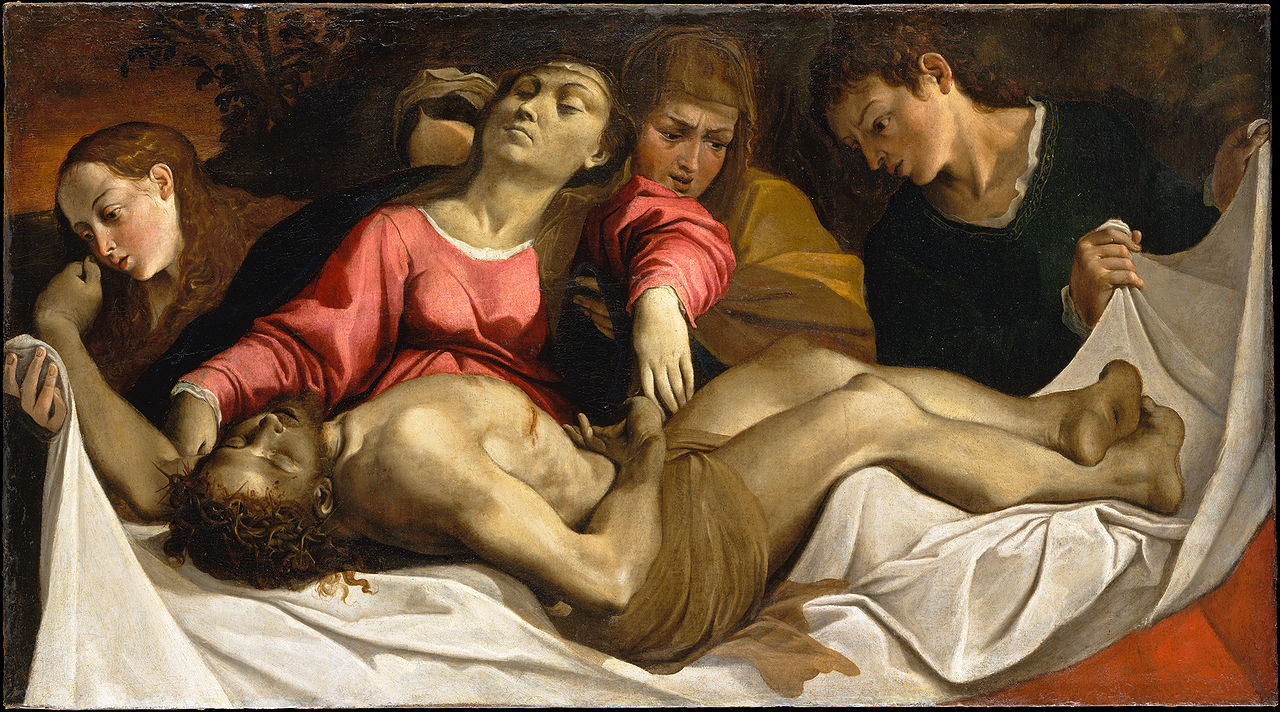
Lamentation of Christ, c. 1582
Ludovico Carracci

Annunciation
Ludovico Carracci

Madonna and Child with Saints, 1586
Agostino Carracci

The Lamentation, 1586
Agostino Carracci

The Butcher’s Shoo, 1583
Annibale Carracci

The Bean eater, 1580 - 1590
Annibale Carracci

Rest on the Flight into Egypt, 1600
Annibale Carracci

Pieta, 1599 - 1600
Annibale Carracci

Landscape with Flight into Egypt, 1604
Annibale Carracci

In his trial in Rome, Caravaggio identified Annibile as one of the 10 best artists in Rome at that time. And it is easy to see why. in addition to his life studies and drawings, Annibale was accomplished in frescoes, a style that evaded Caravvagio. In addition, Annabelle was accomplished in genre scenes and landscapes.

In future posts I will explore the Farnese Gallery frescoes, the legacy of the Carraccis, and the role of the Carracci students in the overall influence and impact of The Bolognese School.


©EverythingElse238

In the Footsteps of Piero della Francesca: Meetup and the Maddalena

Piero della Francesca's import to pre-Renaissance art and how I became involved in a trip to walk in his footsteps have previously bee...