Showing posts with label Mannerism. Show all posts

Wednesday, December 9, 2020

The roots of the anti-Mannerist, proto-Baroque, Bolognese School (1590 - 1630)

The Council of Trent (1545 - 1563), in its attempts to blunt the effects of the Protestant Reformation, issued a number of decrees, including one which welcomed religious imagery as an aid in religious teaching. According to witcombe.sbc.edu, the religious imagery employed in this manner was expected to exhibit:

  • Clarity, simplicity, and intelligibility 
  • Realistic interpretation
  • Emotionally stimulate piety.
While the church was open to the use of painted works to communicate religious messages to the masses, it did not conceive of the then-dominant painting style -- Mannerism -- as being up to the task. Post-1550 Mannerism exhibited (witcombe.sbc.edu):

  • Virtuosity of execution and highly decorative surface qualities go with compositional decentralization and spatial and coloristic complexities
  • Deliberate physical and psychic ambiguities puzzle the beholder
  • Intricacies of handling are often matched by the intricacies of content
  • Many pictures and fresco cycles of the period are obscure and esoteric 
  • Little power to stir religious emotions in the mass of the faithful
  • Lacked clarity, realism, and emotional intensity.
The images below show the difference between Correggio's Noli Me Tangere -- done in the High Renaissance style -- versus the Mannerist representation by Bronzino. 

Noli me Tangere, c. 1525
Antonia da Correggio

Noli me Tangere, 1561
Agnolo Bronzino

Painting in the Late Mannerist style (1550 - 1580) represented "an extraordinary decline in quality" from the High Renaissance. The movement which stepped into the breach was the Bolognese School (c.1590 - 1630), an "anti-Mannerist" art movement founded by the Bolognese-based Carracci family. "Ludovico Carracci and his cousins led the charge in the greatest reform of artistry since Cimabue and Giotto, and the first reactionary art Revolution in Western Art History" (The Carracci and Caravaggio Revolution: Foundations of the Baroque, forums.civfanatics.com). Lets take a look at the family and the fruits of their activities.

The Carracci
Ludovico was the oldest of the trio that included him and his two cousins: Annabile and Agostino. Ludovico was initially apprenticed to the painter Prospero Fontano who, after some time, sought to dissuade him from pursuing that career track because he did not "have the nature for it." Ludovico was not dissuaded, however, and went off to study on his own, traveling through North and Central Italy to study the works of Renaissance painters such as Andrea del Sarto (Florence), Parmagiannino (Parma), Giulio Romano (Mantua), and Titian and Tintoretto ( Enice).

Annibale Caracci's father was a tailor in Bologna. Due to the family's financial circumstances, Annibale was forced to leave school at the age of 11 to begin an apprenticeship with a goldsmith. His training while there included learning to draw and it soon became apparent that he was very talented; so much so that his apprenticeship was switched to the Mannerist painter Bartolomeo Passerotti.

In 1580, Annibale took off on a study tour of northern Italy, stopping in Correggio's studio in Parma and then moving on to Venice where he met up with his brother Agostino. In Venice they studied the works of the painters Titian, Veronese, Giorgione, and Tintoretto and marveled at their mastery of color and light. 

Agostino also started out as a goldsmith's apprentice but turned to painting and was trained, initially, by Prospero Fontano, and then by Passerotti and Domenico Tibaldi. He worked as a reproductive engraver in the late 1570s and visited Venice and Parma in the 1580s before returning to Bologna to aid in the founding of the Carracci Academy.

The Carracci Academy
The Carracci brothers returned to Bologna and collaborated with their cousin Ludovico in the formation of an academy focused on teaching art. The Carracci used the academy to "promote the idea that art should draw directly from nature for its study," and idea that was a direct refutation of Mannerism's focus on complexity and artificiality. The genesis of the school is illustrated in the chart below.

The key innovation for the Carracci was the melding of the design characteristics of Florentine art with the colors of Venetian art and their naturalism into a style that was characterized by clear, simple, direct imagery. This style comported well with the guidelines established by the Council of Trent and was enthusiastically endorsed in Rome. It is thus no coincidence that the Carracci came to dominate the religious art scene and their works began to show up in many churches, chapels, and cathedrals.

They worked together on the Palazzo Fava in 1583 and the Palazzo Magnani in 1590-92. In 1594 Cardinal Farnese invited Annibale to Rome to work on Palazzo Farnese and commissioned him in 1597 to work on the frescoes for the Gallery. He was joined by Agostino for this effort.


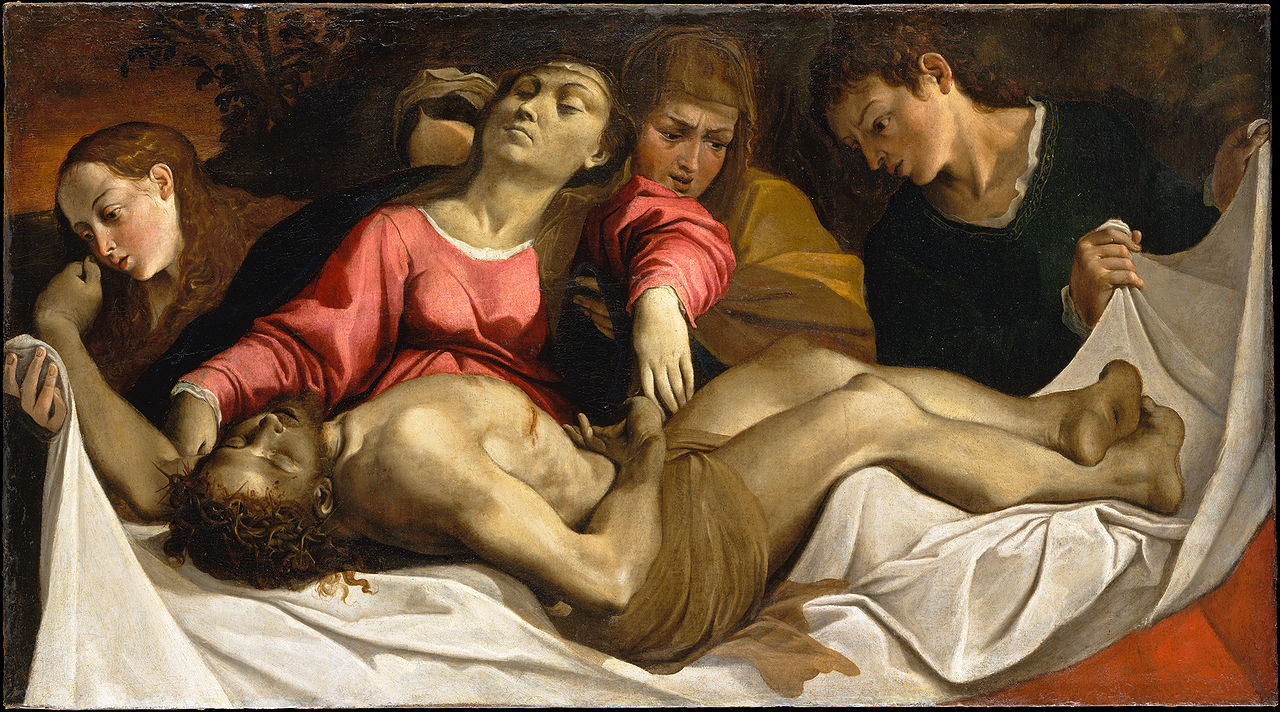
Lamentation of Christ, c. 1582
Ludovico Carracci

Annunciation
Ludovico Carracci

Madonna and Child with Saints, 1586
Agostino Carracci

The Lamentation, 1586
Agostino Carracci

The Butcher’s Shoo, 1583
Annibale Carracci

The Bean eater, 1580 - 1590
Annibale Carracci

Rest on the Flight into Egypt, 1600
Annibale Carracci

Pieta, 1599 - 1600
Annibale Carracci

Landscape with Flight into Egypt, 1604
Annibale Carracci

In his trial in Rome, Caravaggio identified Annibile as one of the 10 best artists in Rome at that time. And it is easy to see why. in addition to his life studies and drawings, Annibale was accomplished in frescoes, a style that evaded Caravvagio. In addition, Annabelle was accomplished in genre scenes and landscapes.

In future posts I will explore the Farnese Gallery frescoes, the legacy of the Carraccis, and the role of the Carracci students in the overall influence and impact of The Bolognese School.


©EverythingElse238

Saturday, November 28, 2020

Catholic Counter-Reformation Art (1560 - 1700)

The Catholic Church had been set back on its heels by the Protestant Reformation -- the "16th-Century religious, political, intellectual, and cultural upheaval that splintered Catholic Europe" (history.com) -- and responded with the Council of Trent (1545 - 1563) and its decrees countering the Reformist agenda.


One of the areas addressed by the Council was art and its role in Catholic Christian life. The dominant style of art at that time was Mannerism but Catholic leaders found this style to be lacking in pious appeal. Religious art of the time, according to the Church:
  • Had lost its focus on religious subject matter
  • Was too much focused on decorative qualities 
  • Was too influenced by classical pagan art.
Examples of this diminished focus on religious subjects, and elevation of style, are demonstrated in Parmigianino's Madonna of the Long Neck and Pontormi's The Deposition.

Madonna of the Long Neck
Parmigianino, 1530 - 33

The Deposition from the Cross
Jacopo Pontormi, 1525 - 28

Michelangelo's The Last Judgement "... came under persistent attack in the Counter-Reformation for, among other things, nudity (later painted over for several centuries), not showing Christ seated or bearded, and including the pagan figure of Charon" (Wikipedia).

The Last Judgment, 1534 - 41
Michelangelo

The interpretations of the art-related dictates issuing from the Council of Trent were as follows:

  • Art was to be direct and compelling in its narrative presentation
  • It was to provide an accurate presentation  of the biblical narrative of the saints' lives, rather than adding anecdotal and imaginary moments
  • It was the duty of all painters to proclaim and explain the truths of the Catholic religion.

Scipione Pulzone's Lamentation was viewed as a work that gave "a clear demonstration of what the holy council was striving for in the new style of religious art ... the focus of the painting giving direct attention to the crucifixion of Christ, it complies with the religious content of the of the council and shows the story of the passion while keeping Christ in the image of the ideal human" (Wikipedia).

Lamentation, 1589
Scipione Pulzone

The Church, the newly formed Jesuits, and wealthy individuals began commissioning works to support this new direction and were provided strong support in Italy, Spain and its colonies (Flanders and Naples), and southern Germany. This new direction is reflected beginning with the efforts of the Bolognese School which itself became a forerunner of the Baroque. I will cover The Bolognese School in my next post on this topic.

©EverythingElse238

    Monday, May 27, 2019

    The Mannerist School (1530 - 1600)

    In its description of the subject of its exhibition Tintoretto: Artist of Renaissance Venice, the National Gallery of Art states "With Titian and Veronese, Tintoretto (c. 1519 - 1594) was one of the three great painters of the golden age of Venetian art, a bold innovator whose works overwhelmed and sometimes outraged his peers." His contemporary (and chronicler of the lives of the great artists) Giorgi Vasari described him as "swift, resolute, fantastic, and extravagant, and the most extraordinary brain that painting has ever produced." Henry James, considered among the greatest English-language novelists, called Tintoretto "The biggest genius who ever wielded a brush."

    Venice born and bred, Tintoretto painted according to the precepts of the Mannerist school. Before discussing the artist, and the aforementioned exhibition, I provide an overview of Mannerism.

    Mannerism, as described herein, is distinctly different from the Antwerp Mannerism that I have previously described. It emerged at the end of the High Renaissance and manifested as a "stylized twist" on Renaissance classicism. The name derives from the Italian word maniera which translates as "style" or "manner." Mannerism is viewed as a bridge between High Renaissance and Baroque. The chart below shows both the context and geographic distribution of the Mannerist school.


    As stated by the Tate Museum,
    Rather than adopting the harmonious ideals associated with Raphael and Michelangelo, Mannerists went a step further to create highly artificial compositions which showed off their techniques and skills in manipulating compositional elements to create a sense of sophisticated elegance.
    Characteristics
    The characteristics of Mannerism are as follows (mymodernmuseum.com, visual-arts-cork.com):
    • Exaggerated figures -- this school rejected realistic proportions and, instead, rendered figures with impossibly elongated limbs and oddly positioned bodies. Two examples are shown below. Note the extended neck of Parmigianino's Madonna and some of the unnatural contortions in Tintoretto's The Last Supper.
    Madonna of the Long Neck
    Parmigianino, 1530 - 33

    The Last Supper
    Tintoretto, c. 1563/1564

    • Elaborate decoration wherein the canvas is covered in an overwhelming abundance of decorative elements
    Vertumnus
    Giuseppe Arcimboldo, c. 1590 - 91

    • Artificial color -- some of the mannerists abandoned the naturalistic colors of the high Renaissance painters and employed garish tones. See below, for example, Pontormi's Deposition from the Cross.

    The Deposition from the Cross
    Jacopo Pontormi, 1525 - 28

    • Pictorial space filled by foreground figures (see Pontormi's Deposition above)
    • The use of light from a single source sometimes abandoned in favor of contrasting effects of light and dark
    Origins
    The figure above (Mannerism in Context) shows a Florentine origin for the school and associates some of the greatest masters with Mannerism. The figure below shows examples of works by Raphael (The Transfiguration) and Michelangelo (The Last Judgment) which are considered Mannerist or Mannerist-leaning. The accompanying Fiorentino effort (Descent from the Cross) is clearly Mannerist and was also created in Florence. Note the similarities between Michelangelo's Last Judgment in the Origins figure and Tintoretto's oil sketch for his Paradiso painting that immediately follows.


    Paradise
    Tintoretto, c. 1583

    But it was in Rome that Mannerism truly blossomed with Parmigianino and many of Raphael's students collaborating to push the genre forward. The success of the movement in Rome led to later Florentine painters such as Vasari (with limited success) and Salviati (much more so) adapting the style. The Rome school also inspired Mannerism's adoption in many major European cities.

    Mannerism never conquered the art space in the way that the Renaissance did. Rather, many artists continued to paint in the High Renaissance style alongside the Mannerist painters. Further, Mannerism was viewed with a jaundiced eye by the Catholic Church which was in the midst of the Counter Reformation battle and did not view the style as advancing its goals. In that the Catholic Church was the leading fine-art patron, its skepticism eventually led to the demise of the school.

    ©EverythingElse238

    Njideka Akunyili Crosby and Norton Museum of Art's RAW: In Retrospect exhibition.

    Over the last few days I have been exploring Norton Museum of Art's Recognition of Women in Art: In Retrospect exhibition and the inclu...