Showing posts with label art. Show all posts

Friday, February 11, 2022

Jamali, creator of postmodernism's Mystical Expressionism

I first met Jamali in Orlando in the mid-90s when one of his paintings was on offer at a charity fundraising event. I got to talking with him and was mesmerized.

Untitled, ca. 1995
Jamali

I subsequently spent some time with him, exploring his philosophy, motivation, goals, and artwork. Since those early days, Jamali has grown to become "one of the most prolific artists in history." I recently re-connected with him at his studio in Winter Park and remain enthralled.

Jamali at his Winter Park Studio earlier this year

In a recent post, I positioned Jamali's Mystical Expressionism -- the moniker used by noted art critic Donald Kuspit to describe his style -- on my Postmodernism timeline.

The chart shows Jamali launching his career simultaneously with the birth of the Neo-Expressionist movement, but continuing to be productive in his chosen domain for 25+ years after the demise of that school. 

Jamali employs a number of unique painting rituals and styles (painting with his feet, fresca tempera, pigmentation on cork, pigment distortion) and his complex surfaces and mystical imagery have been compared to neo-Expressionists Anselm Kiefer and Georg Baselitz while his gestural techniques bring to mind the works of Jackson Pollock and the New York School.

Untitled, ca. 1995
Jamali

Untitled, ca. 1995
Jamali

Let a Thousand Flowers Bloom, 2000
Anselm Kiefer

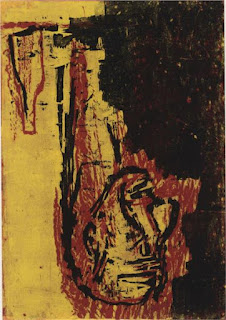
Head and Bottle, 1982
Georg Baselitz

His style is a melding of contemporary consciousness and arts most ancient traditions. In our most recent conversation, Jamali pointed to a long tradition of mysticism in art reaching back to the Egyptian Scribes and, even further back, to the artists responsible for the pre-historic European cave paintings.

Untitled, ca. 1995
Jamali

The material for his work is sourced from his dreams (similar to some of the prominent surrealists) with his paintings "... inhabited by dream figures that appear and then fade away." His persistent themes and mythic imagery define a single artistic vision which he has dubbed Art and Peace.

Untitled, ca. 1995
Jamali

His life's work is unmatched in its scope, as it relates to variety and spiritual depth. But there are also more tangible manifestations of its scope:
  • He has produced more paintings than any other artist, including Picasso
  • He is one of the most collected artists in the world with his works featured in the collections of personalities such as Elton John, Emeril Lagasse, Jack Welch, Kelsey Grammer, King Abdullah II of Jordan, and Oprah Winfrey
  • The Jamali Foundation is the largest single-artist foundation in the world.
Jamali is now in the process of raising funds to establish a museum in Orlando to display his held works.

©EverythingElse238

Tuesday, January 11, 2022

Postmodernism -- and Jean-Michel Basquiat's place therein

Modernism, as discussed in a prior post, "sought a new alignment with the experience and values of modern industrial life" but, by the middle of the 20th century, "modern life" had been disrupted (The Art Story):

  • The world had experienced two world wars with millions of lives lost
  • Nuclear weapons had been used 
  • Communist ideals had been shattered, partly by its own weight and partly by a re-invigorated post-war capitalism.

Societal changes had been accompanied by changes in the art world: The center of avant-garde painting had shifted from Europe to NYC and Abstract Expressionism, and its practitioners, were flourishing. 

It was at this point that the first cracks begun to appear in the modernist superstructure as young artists began to question the relevance of the art for the times as well as the perch occupied by the feted artists. Artists like Jasper Johns and Robert Rauschenberg began to experiment with new styles that borrowed and recreated imagery from the mass culture that surrounded them. This was the beginning of the neo-Dada movement -- "the first of the genuinely postmodern movements" -- which would itself give rise to other postmodern movements such as POP Art and Minimalism.

The chart immediately below captures the main postmodernist movements while the two images following show works created by Johns and Rauschenberg during the neo-Dada period.

Monogram, 1955 - 1959
Robert Rauschenberg

White Flag, 1955
Jasper Johns

If neo-Dada is the first of the postmodern movements, what exactly is postmodernism. According to MOMA, it is a reaction against modernism, "less a cohesive movement than an approach and attitude toward art, culture and society" whose main characteristics include:

  • Anti-authoritarianism
  • Collapsing of the distinction between high culture and mass or popular culture
  • Collapsing of the distinction between art and everyday life
  • A deliberate use of earlier styles and conventions
  • An eclectic mixing of different artistic and popular styles and media.
Selected pieces of postmodern art are depicted below.

Marilyn Diptych, 1962
Andy Warhol

The Physical Impossibility of Death in the Mind of Someone Living, 1991
Damien Hirst

Untitled, c. 1996
Jamali

Jean-Michel Basquiat
Jean-Michel Basquiat transitioned from the text-focused Graffiti Art to the imagery-based Neo-Expressionism movement, a movement described by Phoebe Hoban, in her book Basquiat: A Quick Killing in Art, as
...  merely a trendy fashion statement, a bleep on the radar ... The Abstract Expressionists came together to promote a cause, while the East Village artists came together to promote themselves.
Jean-Michel Basquiat
By Source, Fair use, https://en.wikipedia.org/w/index.php?curid=29602496

Basquiat was born in Brooklyn in 1960. One of the seminal events in his youth was being hit by a car in the street of his residence, necessitating a lengthy rehabilitation. During his rehab, his mother gave him a copy of the Book Gray's Anatomy which he studied assiduously. The influence of that book is apparent in much of his art.

Jean-Michel dropped out of school prior to graduation and fell into the graffiti culture which was then taking off in Brooklyn and the Bronx. He tagged with a fellow artist under the moniker Samo© but when they fell out, he killed off the designation.

New York City was falling apart at this time. It was deep in debt and awash in deserted and abandoned buildings. The cheap rent attracted artists to the Lower East Side and this mish mosh of practitioners from all branches of the arts yielded a unique, gritty culture. Basquiat fell right into this, steering away from graffiti and wanting to be considered an artist.

During this time he could not afford art supplies so he painted on anything that was available -- scraps of paper, doors from abandoned buildings, etc. His artistic skills began to be noticed but his sprint to the top really began with his participation in the January 1981 art show at PS1 in Queens that was organized by Diego Cortez. Basquiat's path to stardom post that meeting is shown in the chart below.


Untitled (Word on Wood) is one of 17 Basquiat paintings that incorporates wood fence slats. The slats are painted black and divided into two unequal hemispheres. The upper hemisphere is dominated by a blue square with a gold border which serves as a frame for an African-mask-like structure with mismatched oval eyes and bared teeth. A line runs from a distinctly negroid nose through a unibrow to the top of the forehead, dividing the forehead into two unequally adorned hemispheres. The top of the head is festooned with light-brown, cornrow-type structures.

The lower hemisphere is populated by some of the markings for which Basquiat is known. The left, chair-like structure is brown in color and associated with a white comb marking while the right leg is entwined by a green vine and is adjacent to an upturned comb.

Untitled (Word on Wood), 1985
Jean-Michel Basquiat

Yellow Door is a collage of different textured items emplaced on a bright-yellow, two-hemisphere, wooden door. The Spanish word for miracle is repeated a number of times on the structure's upper hemisphere.

Yellow Door (1960), 1985
Jean-Michel Basquiat

Selected additional Basquiat paintings are shown below.

Untitled (Self-Portrait), 1982
Oilstick and ink on paper

Untitled (Man with Microphone), 1982
Oilstick on paperboard

Per Capita, 1981
Acrylic and oilstick on canvas

Arroz con Pollo, 1981
Acrylic and oilstick on canvas

Warrior, 1982
Acrylic and oilstick on wood panel

Untitled, 1982
Acrylic, oilstick, and spray paint on wood

Untitled, 1982
Acrylic, oilstick, and spray paint on wood

Untitled, 1981
Acrylic and oilstick on canvas

Untitled (tenant), 1982
Acrylic and oilstick on canvas

Self-Portrait with Suzanne, 1982
Oilstick on paperboard

Cathleen McGuigan (New York Times, 2/10/85) provides a comprehensive description of Basquiat's paintings:
His color-drenched canvasses are peopled with primitive figures wearing menacing, masklike faces, painted against fields jammed with arrows, grids, crowns, skyscrapers, rockets and words ... His drawings and paintings are edgy and raw, yet they resonate with the knowledge of such modern masters as Dubuffet, Cy Twombly or even Jasper Johns.
Table 1. Characterizing Basquiat's talent
NameProfessionAssessment
Sandro Chia (after the PS1 show)Painter (Italian)“Basquiat’s paintings captured the spontaneity of the City”
“The paintings were full of disparate elements that somehow worked together though there was no apparent system linking them”
John RussellChief art critic, New York Times“Basquiat proceeds by disjunction — that is by making marks that seem quite unrelated, but that turn out to get on very well together”
Vivian RaynorNew York Times Writer“The educated quality of Basquiat’s line and the stateliness of his compositions both of which bespeak a formal training that, in fact, he never had.”
Data Source: Cathleen McGuigan, New Art, New Money, NYT, 2/10/85

Jean-Michel Basquiat died of an overdose in 1988. He was 28 years old.

©EverythingElse238

Wednesday, January 5, 2022

Abstract Expressionism in the Modernism canon

Modernism, according to tate.org.uk, "refers to a global movement in society and culture that from the early decades of the twentieth century sought a new alignment with the experience and values of modern industrial life. Building on late nineteenth century precedents, artists around the world used new imagery, materials and techniques to create artworks that they felt better reflected the realities and hopes of modern societies." A second source (the collector.com) is in agreement with this definition except that (i) they limit it to the western world and (ii) they see it as a complete break with everything that went before (rather than a "build").

Many different styles are encompassed by the term modernism but they all are bound by a set of underlying principles (Tate):

  • A rejection of history and conservative values
  • Innovation and experimentation with form with a tendency to abstraction
  • An emphasis on materials, techniques, and processes.

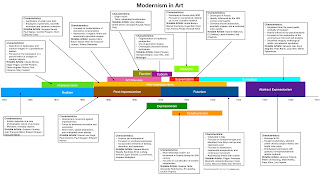
A graphical representation of the various art movements encompassed in the term modernism is provided below.


Abstract Expressionism

In the early 1940s, the East Village became the stomping grounds for a number of artists who congregated there, sharing ideas in a manner akin to the Impressionists in Montmartre. These artists shared "an interest in using abstraction to convey strong emotional or expressive content" and a "characteristic messiness and extremely energetic application of paint." These artists eschewed narrative and symbolism in their work, exploring, instead, "the literal act of applying paint to the canvas."


The figure below presents a graphical overview of the key characteristics of the movement.


Phoebe Hoban, in her book Basquiat: A Quick Killing in Art, compared the Abstract Expressionism movement to the later -- but geographically co-located -- Neo-Expressionism movement

... while the first movement shifted the tectonic plates of the art world from Paris to New York and shaped Western culture for the second half of the twentieth century, the second movement was merely a trendy fashion statement, a bleep on the radar ... The Abstract Expressionists came together to promote a cause, while the East Village artists came together to promote themselves.

According to Phoebe, the Abstract Expressionists put themselves on the map with a show on Ninth Street in 1951. Sixty-one artists displayed 61 pieces of art, the first time that the general public had had an opportunity to see the full scope of the movement's coverage. 


Action Painting

One of the Abstract Expressionist works that I find especially interesting is Franz Klines Untitled. In the figure above, which describes key influences for the Abstract Expressionists, I mentioned the role of chance in the contours of the final product. Other action painters like Willem de Kooning and Jackson Pollock were dyed-in-the-wool improvisationalists. Kline's approach, however, "was methodical and meticulously planned before execution. His paintings started as drawings, which he projected at a larger scale onto canvas."


Franz Kline
Untitled, 1960
Oil on paper


The other works that I found appealing in this section are shown below.

Hans Hoffman
Composition #3, 1956
Oil on canvas

Jean Miotte
Untitled, 1958
Oil on canvas

Willem de Kooning
Woman II, 1961
Oil on paper mounted on canvas

Helen Frankenthaler
February's Turn, 1979
Acrylic on canvas

Michael Goldberg
The Keep, 1958
Oil on canvas

Joan Mitchell
Aire pour Marion (Space for Marion), 1975-76
Oil on canvas

Mark Rothko
Untitled, 1968
Oil on paper mounted on canvas

Theodoros Stamos
Sentinel, 1962-64
Oil on canvas

Expressionism and Repetition
Wherein the artists in the prior section reveled in spontaneity, chance, and improvisation, the artists spotlighted in this section were focused on symmetry and bounding colors within geometric shapes. The work by Richard Anuszkiewicz has a somewhat hypnotic look to it, with the green distinctly separated from the red. On closer examination one can be sucked into the myriad, connector-like lines that constitute that outer red layer. A truly complex construct.

Josef Albers
Study for Homage to the Square, 1964
Oil on blotting paper

Richard Anuszkiewicz
Temple to Royal Green, 1983
Acrylic on canvas

Frank Stella
New Caledonian Lorikeet, 1980
Mixed media on Tycore Board

Kenneth Noland
Summer's Gold, 1983
Acrylic on canvas

©EverythingElse238

Monday, June 17, 2019

Romanists in the Northern Renaissance

The Renaissance art movement in the Low Countries began with van Eyck and the Early Netherlandish (Flemish Primitives) movement and stretched through the end of the century. Within this broader Northern Renaissance there are a number of strains (Early Netherlandish, Antwerp Mannerists, etc.) and schools (Antwerp School, Haarlem School, Leyden School, etc.). I have explored the Early Netherlandish and Antwerp Mannerist strains to date and, in this post, will cover the Romanist strain.

Romanists (Romanism) refers to Low Country artists who, at some point in their career, visited Rome, studied the works of the Italian masters, and, upon their return, incorporated those learnings into their painterly works. This Italianate influence was reflected in a greater emphasis on human form, the addition of classical myths and legends to the artist's repertoire, and inclusion of classic Roman architecture in the painted scene. The works of these artists were primarily religious and mythological and included anatomically correct human beings in contrived poses.

The chart below shows the artists who are known to have travelled to Rome during the first half of the 16th-century (It should be noted that Bernard van Orly, even though he painted in this style, did not ever actually travel to Rome.).


The first Low Country artist to make the trek over the Alps was Jan Gossaert. His patron at the time was Philip of Burgundy and Gossaert traveled as a part of his entourage on a diplomatic trip to Rome. While there Gossaert recorded antique monuments for the art-loving Prince.

The Adoration of the Kings (shown below) is a Gossaert painting in the traditional Early Netherlandish style.

The Adoration of the Kings, 1510 - 1515
Jan Gossaert

It stands in sharp contrast to the first work which reflected his Renaissance learnings -- Neptune and Amphitrite, painted in 1516. These "startlingly large" human representations were the first nudes in the history of Flemish art. The elongation of the figures brings to mind the Gooseneck Madonna of Mannerist fame. In addition to the mythological theme and the nude bodies, the architecture is also drawn from the classic world. Amphitrite's left hand is in a fairly awkward position in this effort.

Neptune and Amphitrite, 1516
Jan Mossaert

His Hercules and Deianira, while exhibiting lower-mass nudes, similarly places them in fairly awkward poses with the intertwining of legs and the relative squareness of Hercules torso vis a vis his lower body.

Hercules and Deianira, 1517
Jan Gossaert

Examples of other Romanist works are shown below. In the case of the van Jeemskerck paintings, the first was painted prior to his trip to Rome, and the second after his return.

The Dying Cleopatra, c. 1522
Jan van Scorel

Saint Luke Painting the Virgin, 1532
Maarten van Heemskerck

Saint Luke Painting the Virgin, 1538 - 40
Maarten van Heemskerck

Original Sin, ?
Michiel Coxcie

Altarpiece of Saints Thomas and Matthias, 1510 - 1520
Bernard van Orley

There was renewed Low-Countries-artist interest in Rome during the last third of the century, driven primarily by the Italian-originated Mannerist movement. Painters who traveled to Rome during that period include Dirck Barandsz, Adriaen de Weerdt, Hans Speckaert, Bartholamäus Spranger, Hendrik Goltzus, and Joachim Wteweel. I will cover this Northern Mannerist movement in a subsequent post.


©EverythingElse238

In the Footsteps of Piero della Francesca: Queen of Sheba, King Solomon, and Burial of the Wood

Just below the Death of Adam in Basilica di San Francesca's Bacci Chapel is the two-scene fresco Procession of the Queen of Sheba and M...