
Showing posts with label Northern Renaissance. Show all posts
Showing posts with label Northern Renaissance. Show all posts
Sunday, August 11, 2019
Summary of the major Low-Countries Northern Renaissance art movements
I recently embarked on multi-post effort to provide an overview of Dutch and Flemish art in the periods covered in a number of major current, and recently concluded, international art exhibitions. To date I have covered all of the major strains associated with the Northern Renaissance period and I summarize those in the chart shown below.

©EverythingElse238

Sunday, July 28, 2019
Northern Mannerism: The Flemish Experience (1560 - 1600)
Artists from the Low Countries had been traveling to Italy since the early part of the 16th century -- Jan Gossaert was the first to make the trip in 1509 -- but, to a large extent, the Netherlandish painting style remained aloof from Italian Renaissance influences. Those artists who did reflect some Italian influence in their work in the first half of the 15th century became known as Romanists. The Italianate influence was reflected in: (i) a greater emphasis on human form; (ii) the addition of classical myths and legends to the artist's repertoire; and (iii) inclusion of Classic Roman architecture in the painted scene. The works of these artists were primarily religious and mythological and included anatomically correct human beings in contrived poses.
Frans Floris (1520 - 1570)
Floris primarily painted religious works and Classical allegories in a "rather artificial style that borrowed heavily from Michelangelo and the Italian Mannerists in its elegant rhetoric and cool eroticism" (Vlieghe).
In his transition to Mannerism he took a less sculptural approach to the figures in his paintings and his palette became more monochromatic. His later Mannerist style evidenced some influence from the Fontainebleau School in that his figures became more elegant and his output more refined.
The Mannerist style that Floris evolved remained dominant in Flanders until the end of the 16th century. Floris never recovered from seeing his paintings destroyed during the furies and virtually stopped painting after 1566.
****************************************************************************************************************************
A great number of altarpieces had been destroyed or disappeared during the iconoclastic furies and a major effort was undertaken to replace them. Frans Floris had ceased painting but a large number of young painters (who had either been trained by Floris, or had made the trip to Italy and so was familiar with the Mannerist style, or both) were available to take up the task. Application of these learnings to the production of the new art varied widely, however. Some artists went back to their Netherlandish roots, while others fully applied the Mannersist idioms, while still others implemented a hybrid approach. One of the painters in the highest demand during this period was Marten de Vos.
Marten de Vos (1532 - 1603)
De Vos was trained by his father and Frans Floris and traveled to Rome in the company of Pieter Bruegel the Elder. He resided in Italy from 1550 to 1558 and worked in Tintoretto's studio in Venice. When de Vos returned to Antwerp in 1558, Floris was the leading history painter in Flanders and it was very difficult for young painters to gain commissions.
His paintings in the 1560s and 1570s clearly reflected his Floris training and the time that he had spent in Italy. His early paintings, according to Hans Vlieghe (Flemish Art and Architecture, 1585 - 1700), "... can easily be recognized by the gracefully stylized and elongated poses of the figures, with their sometimes emphatic distortions as well as in the typical Raumflucht effects of foreshortening and perspective." His Mannerist styling is displayed in The Dream of Pilate's Wife.
Withe the passage of time, and an increase in commissions and fame, the Mannerist idioms began to slip out of de Vos' compositions. In the altarpiece Christ showing his wounds to Thomas, "a tempered Mannerism is combined with a preference for narrative that is more in line with Netherlandish tradition" (Vlieghe). In Saint Luke painting the Virgin, the Mannerist elements are almost totally missing.
Ambrosius and Frans Francken
The Francken brothers exhibited a similar painting style to Marten de Vos. Born into a successful painting family, Hieronymus, Ambrosius, and Frans Francken trained under Frans Folis. Ambrosius and Hieronymus went to Fontainbleau upon completing training in 1570, with Ambrosius returning to Antwerp in 1573. Ambrosius, like de Vos, capitalized on the need for large altar pieces post the Reformation. His style is characterized as "descriptive realism with reminiscenses of the Early Netherlandis traditions ... combined with the portrayal of Mannerist physical contortions derived from the late-16th-century Tuscan-Roman art."
Frans Francken exhibited a similar style in his works.
Hendrik de Clerck (1570 - 1630)
Hendrik de Clerck, the foremost artist in Brussels in his day, was a student of De Vos and the teacher's work served as his starting point. He served as the Court painter to Ernest, Archduke of the Netherlands as well as his successors, Albert and Isabella.
De Clerck painted a significant number of altarpieces to replace those damaged in churches and monasteries. As did De Vos, he sought a Netherlandish-tradition-based realism but his "weak and sometimes apparently elongated poses, together with the more sentimental facial expressions of his characters, also betray knowledge of the style of Parmigianino, with which De Clerck must first have become familiar in Italy" (Vlieghe).
Vlieghe sees De Clerck's emotionally charged Mannerism as akin to the Haarlem Mannerists but subordinated to "clear and well organized composition." His general characteristics include hard, rather metallic linearity and boniness of the male face, starkly accentuated by the sculptural effect of light.
****************************************************************************************************************************
It was almost a rite of passage for a Flemish painter to travel to Italy upon completion of his apprenticeship and, while their, to study the masters, the Classics, and, in the latter part of the 16th century Mannerism." But these painters were also schooled in the Netherlandish traditions and we see that, when called upon to deliver the large numbers of religious paintings required after the Reformation, they employed a watered-down Mannerism in the eventual solution. In the case of Marten de Vos, his later paintings contained no Mannerist idioms.
I will treat the Haarlem Mannerists in my next post.
©EverythingElse238
Mannerism arose in Florence towards the end of the High Renaissance but came into full flower in Rome from whence it was exported to points north. This "Northern Mannerism" had unique individual flavors depending on the geographic region in which it took root. For example, the French strain of Northern Mannerism was referred to as the Fontainebleau School and was characterized by an innate elegance.


The type of Mannerist expression encountered in Antwerp prior to the religious troubles differed from the Counter-Reformation-compliant art in evidence during the re-furnishing of places of worship which, in turn, differed from the Haarlem Mannerism with its Prague-infused roots. I will examine Northern Mannerism on both sides of the post-1585 Low-Countries-dividing line beginning, in this post, with the Flemish experience.
Floris, known in his day as the Flemish Raphael, is a clear link between the Romanist and Mannerist styles in that his works done around 1545 were Romanist while those done post-1560 were Mannerist.
 |
| Frans Floris |
Floris studied in Rome from 1541 to 1545, and upon his return established a large successful school (over 120 graduates) while also cornering the market for drawings for engravers. All printmakers active in the Netherlands between 1550 and 1570 worked from his designs.
Floris primarily painted religious works and Classical allegories in a "rather artificial style that borrowed heavily from Michelangelo and the Italian Mannerists in its elegant rhetoric and cool eroticism" (Vlieghe).
In his transition to Mannerism he took a less sculptural approach to the figures in his paintings and his palette became more monochromatic. His later Mannerist style evidenced some influence from the Fontainebleau School in that his figures became more elegant and his output more refined.
 |
| Banquet of the Gods, 1550 Frans Floris |
 |
| The awakening of the Arts, 1560 Frans Floris |
The Mannerist style that Floris evolved remained dominant in Flanders until the end of the 16th century. Floris never recovered from seeing his paintings destroyed during the furies and virtually stopped painting after 1566.
****************************************************************************************************************************
A great number of altarpieces had been destroyed or disappeared during the iconoclastic furies and a major effort was undertaken to replace them. Frans Floris had ceased painting but a large number of young painters (who had either been trained by Floris, or had made the trip to Italy and so was familiar with the Mannerist style, or both) were available to take up the task. Application of these learnings to the production of the new art varied widely, however. Some artists went back to their Netherlandish roots, while others fully applied the Mannersist idioms, while still others implemented a hybrid approach. One of the painters in the highest demand during this period was Marten de Vos.
Marten de Vos (1532 - 1603)
De Vos was trained by his father and Frans Floris and traveled to Rome in the company of Pieter Bruegel the Elder. He resided in Italy from 1550 to 1558 and worked in Tintoretto's studio in Venice. When de Vos returned to Antwerp in 1558, Floris was the leading history painter in Flanders and it was very difficult for young painters to gain commissions.
His paintings in the 1560s and 1570s clearly reflected his Floris training and the time that he had spent in Italy. His early paintings, according to Hans Vlieghe (Flemish Art and Architecture, 1585 - 1700), "... can easily be recognized by the gracefully stylized and elongated poses of the figures, with their sometimes emphatic distortions as well as in the typical Raumflucht effects of foreshortening and perspective." His Mannerist styling is displayed in The Dream of Pilate's Wife.
 |
| The dream of Pilate's Wife Marten de Vos |
Withe the passage of time, and an increase in commissions and fame, the Mannerist idioms began to slip out of de Vos' compositions. In the altarpiece Christ showing his wounds to Thomas, "a tempered Mannerism is combined with a preference for narrative that is more in line with Netherlandish tradition" (Vlieghe). In Saint Luke painting the Virgin, the Mannerist elements are almost totally missing.
 |
| Christ showing his wounds to Thomas, 1574 Marten de Vos |
 |
| Saint Luke painting the Madonna, 1602 Marten de Vos |
Ambrosius and Frans Francken
The Francken brothers exhibited a similar painting style to Marten de Vos. Born into a successful painting family, Hieronymus, Ambrosius, and Frans Francken trained under Frans Folis. Ambrosius and Hieronymus went to Fontainbleau upon completing training in 1570, with Ambrosius returning to Antwerp in 1573. Ambrosius, like de Vos, capitalized on the need for large altar pieces post the Reformation. His style is characterized as "descriptive realism with reminiscenses of the Early Netherlandis traditions ... combined with the portrayal of Mannerist physical contortions derived from the late-16th-century Tuscan-Roman art."
Frans Francken exhibited a similar style in his works.
 |
| The Martyrdom of St. Crispin and St. Crispinian Ambrosius Francken |
 |
| Christ among the Scribes, 1586 Frans Francken |
Hendrik de Clerck (1570 - 1630)
Hendrik de Clerck, the foremost artist in Brussels in his day, was a student of De Vos and the teacher's work served as his starting point. He served as the Court painter to Ernest, Archduke of the Netherlands as well as his successors, Albert and Isabella.
 |
| Self-Portrait Hendrik de Clerck |
Vlieghe sees De Clerck's emotionally charged Mannerism as akin to the Haarlem Mannerists but subordinated to "clear and well organized composition." His general characteristics include hard, rather metallic linearity and boniness of the male face, starkly accentuated by the sculptural effect of light.
 |
| The Judgment of Midas, c. 1600 Hendrik de Clerck |
****************************************************************************************************************************
It was almost a rite of passage for a Flemish painter to travel to Italy upon completion of his apprenticeship and, while their, to study the masters, the Classics, and, in the latter part of the 16th century Mannerism." But these painters were also schooled in the Netherlandish traditions and we see that, when called upon to deliver the large numbers of religious paintings required after the Reformation, they employed a watered-down Mannerism in the eventual solution. In the case of Marten de Vos, his later paintings contained no Mannerist idioms.
I will treat the Haarlem Mannerists in my next post.
©EverythingElse238
Wednesday, July 17, 2019
Transmission of Bruegel's techniques and topics into the Dutch Republic
The fall of Antwerp to the Duke of Parma in 1585 signaled the effective partition of the Low Countries into the Spanish Netherlands and the United Provinces and precipitated the flight of non-Catholics to the north, the Pfalz region of Germany, and England.
Migration actually began with the iconoclastic riots in 1566, intensified when Spain secured strongholds in Flanders and Brabant in the late 1570s, and became a flood with the fall of Antwerp in 1585 and the years immediately after. In the years following 1585, about 38,000 refugees left Antwerp for other shores.
In this post we will focus on the refugee situations in Haarlem and Amsterdam as they were the main beneficiaries of the Brugelian legacy.
Haarlem
A devastating fire in 1576 had destroyed over 400 homes, leaving large spaces open for development. When refugees flowed out of Flanders beginning in the late 1570s, Haarlem had available space on which to resettle them. Further, a treaty signed with William the Silent in 1981 allowed the city to repurpose the property of former monasteries, thus providing additional capacity for refugee support.
The first wave of refugees were drawn from the linen and cloth industries in the south and were followed by the professional class beginning in 1578. The City Magistrate offered subsidies and other perks to lure professionals to set up shop within the city gates.
Flemish artists were among the professionals who made their way to Haarlem. The iconoclastic wars of the summer of 1576 had introduced challenges to the Antwerp artistic community and many had packed their bags and headed for Amsterdam, Middleburg, and Haarlem.
The inflow of artistic talent helped to jump-start the Haarlem art market:
Going to Amsterdam was a risky decision for an Antwerp painter as it was still a relative backwater in 1585. From 1585 onwards Amsterdam rapidly caught up with Antwerp thanks to the steady stream of refugees arriving from Flanders and Brabant. What had been a modest provincial town became a bustling metropolis with population rising from 27,000 to 60,000 between 1585 and 1600. This increase in population had a significant positive effect on Amsterdam's economy and as purchasing power grew, so did the demand for art.
The Antwerp painter population decreased by 50% after 1585. One of the beneficiaries, Amsterdam, saw its painter population grow rapidly such that, by 1990, the painter population in both cities was almost equal. Between 1585 and 1600 there were 112 painters registered in Amsterdam, 31 of whom had been born in Antwerp and 24 of the 31 had been active in Antwerp before settling in Amsterdam.
*****************************************************************************************************************************
It is within this environment, and under these conditions, that the Brueghel techniques and topics made their way into the painting scene in the North. The chart below shows the painters who were primarily responsible for the transfer of the Bruegelian themes and techniques from the Spanish Netherlands to the United Provinces.

This group of painters, sometimes referred to as the Amsterdam Circle of Flemish Painters, remained faithful to Bruegelian model and traditions.
Landscape Painting
In the United Provinces, landscapes were primarily done in the Mannerist style. An example from the Utrecht artist Abraham Bloemaert is shown below.
With the arrival of the Flemings, some of Bruegel's formulas for landscape painting -- especially his thick-forest wilderness -- begin to make their presence felt.
Alongside Jan Bruegel the Elder, Gillis van Coninxloo (1544 - 1607) is the painter usually credited with making the greatest contribution to the development of images in forest settings. Van Coninxloo studied under Pieter Coecke van Aelst (Bruegel the Elder's teacher and father-in-law); taught Pieter Bruegel the Younger; and strongly influenced the works of Jan Bruegel the Elder, Roelandt Savery, and David Vinckboons. Van Coninxloo's early landscapes were influenced by Bruegel the Elder. Note the thick-forest landscape in the painting below.
Jacob Savery (1545 - 1603) was a student of Hans Bol and himself taught his brother Roelandt Savery (1576 - 1635). All of his landscape paintings in the 1584 - 1586 period show strong Brueglian influences.Unfortunately Savery is also known for forging a number of works by signing Bruegels name to the paintings and ascribing them dates during which Bruegel was still alive. These forgeries have been discovered and the paintings re-assigned to Savery.
Hendrick Goeltzius (1558 - 1616) is usually given pride of place in the establishment of an independent Dutch landscape style because of his drawings of panoramic views in the vicinity of Haarlem. His indebtedness to Bruegel is twofold. First, the dot-and-stipple technique that he used to render light and atmosphere derives from Bruegel. Second, Goeltzius was a Spranger-level Mannerist prior to his own trip to Rome in 1590. Upon his return, he began paying fresh attention to Flemish landscapists such as Hans Bol (and Bol, as we know, was one of the foremost Bruegel the Elder disciples).
Winter Landscape with Skaters
Hans Bol, Coninxloo, the Savery brothers, and Vinckboons all transmitted this style to a new generation in 17th-century Holland.
Peasant Subjects
This is a crucial part of Bruegel's contribution and a major staple of the emigré community. David Vinckboons, along with Hans Bol and Roelandt Savery, was instrumental in the development of genre painting in the Netherlands. His Kermis and other village vistas were influenced by Bruegel and he is considered second only to Pieter Bruegel the Younger as a paradigmatic Bruegel follower.
Jan Steen (1610 - 1690) was one of the most famous of the 17th-century peasant-life painters. He ewas born in Antwerp and enjoyed immense popularity during the course of his life. He is linked to Bruegel through the peasant scenes -- a more refined version of Brouwer's efforts -- and his marriage to the daughter of Jan Brueghel the Elder. He was eventually hired by Archduke Leopold William as the Court Painter and the Keeper of the Art Collections.
With the turn of the century the Netherlandish style of painting began to recede in the face of the Baroque onslaught but the techniques and topics associated with Pieter Bruegel the Elder were seamlessly incorporated into this new art expression.
©EverythingElse238
Migration actually began with the iconoclastic riots in 1566, intensified when Spain secured strongholds in Flanders and Brabant in the late 1570s, and became a flood with the fall of Antwerp in 1585 and the years immediately after. In the years following 1585, about 38,000 refugees left Antwerp for other shores.
In this post we will focus on the refugee situations in Haarlem and Amsterdam as they were the main beneficiaries of the Brugelian legacy.
Haarlem
A devastating fire in 1576 had destroyed over 400 homes, leaving large spaces open for development. When refugees flowed out of Flanders beginning in the late 1570s, Haarlem had available space on which to resettle them. Further, a treaty signed with William the Silent in 1981 allowed the city to repurpose the property of former monasteries, thus providing additional capacity for refugee support.
The first wave of refugees were drawn from the linen and cloth industries in the south and were followed by the professional class beginning in 1578. The City Magistrate offered subsidies and other perks to lure professionals to set up shop within the city gates.
Flemish artists were among the professionals who made their way to Haarlem. The iconoclastic wars of the summer of 1576 had introduced challenges to the Antwerp artistic community and many had packed their bags and headed for Amsterdam, Middleburg, and Haarlem.
The inflow of artistic talent helped to jump-start the Haarlem art market:
- Local artists were exposed to new genres
- These new entrants set up workshops in their new homeland
- Talented local youth were taken under the wings of these refugee masters.
Going to Amsterdam was a risky decision for an Antwerp painter as it was still a relative backwater in 1585. From 1585 onwards Amsterdam rapidly caught up with Antwerp thanks to the steady stream of refugees arriving from Flanders and Brabant. What had been a modest provincial town became a bustling metropolis with population rising from 27,000 to 60,000 between 1585 and 1600. This increase in population had a significant positive effect on Amsterdam's economy and as purchasing power grew, so did the demand for art.
The Antwerp painter population decreased by 50% after 1585. One of the beneficiaries, Amsterdam, saw its painter population grow rapidly such that, by 1990, the painter population in both cities was almost equal. Between 1585 and 1600 there were 112 painters registered in Amsterdam, 31 of whom had been born in Antwerp and 24 of the 31 had been active in Antwerp before settling in Amsterdam.
*****************************************************************************************************************************
It is within this environment, and under these conditions, that the Brueghel techniques and topics made their way into the painting scene in the North. The chart below shows the painters who were primarily responsible for the transfer of the Bruegelian themes and techniques from the Spanish Netherlands to the United Provinces.

This group of painters, sometimes referred to as the Amsterdam Circle of Flemish Painters, remained faithful to Bruegelian model and traditions.
Landscape Painting
In the United Provinces, landscapes were primarily done in the Mannerist style. An example from the Utrecht artist Abraham Bloemaert is shown below.
 |
| Niobe mourning her children, 1591 Abraham Bloemaert |
With the arrival of the Flemings, some of Bruegel's formulas for landscape painting -- especially his thick-forest wilderness -- begin to make their presence felt.
Alongside Jan Bruegel the Elder, Gillis van Coninxloo (1544 - 1607) is the painter usually credited with making the greatest contribution to the development of images in forest settings. Van Coninxloo studied under Pieter Coecke van Aelst (Bruegel the Elder's teacher and father-in-law); taught Pieter Bruegel the Younger; and strongly influenced the works of Jan Bruegel the Elder, Roelandt Savery, and David Vinckboons. Van Coninxloo's early landscapes were influenced by Bruegel the Elder. Note the thick-forest landscape in the painting below.
 |
| Forest landscape, 1591 Gillis van Coninxloo |
 |
| Landscape with a hunting party and an overturned wagon David Vinckboons |
Jacob Savery (1545 - 1603) was a student of Hans Bol and himself taught his brother Roelandt Savery (1576 - 1635). All of his landscape paintings in the 1584 - 1586 period show strong Brueglian influences.Unfortunately Savery is also known for forging a number of works by signing Bruegels name to the paintings and ascribing them dates during which Bruegel was still alive. These forgeries have been discovered and the paintings re-assigned to Savery.
 |
| Landscape with the story of Jephte's Daughter, 1585 Jacob Savery |
 |
Mountainous Landscape with the return of Jacob from Canaan, 1595
Hans Bol
|
Hendrick Goeltzius (1558 - 1616) is usually given pride of place in the establishment of an independent Dutch landscape style because of his drawings of panoramic views in the vicinity of Haarlem. His indebtedness to Bruegel is twofold. First, the dot-and-stipple technique that he used to render light and atmosphere derives from Bruegel. Second, Goeltzius was a Spranger-level Mannerist prior to his own trip to Rome in 1590. Upon his return, he began paying fresh attention to Flemish landscapists such as Hans Bol (and Bol, as we know, was one of the foremost Bruegel the Elder disciples).
 |
Mountainous Coastal Landscape, 1558 - 1617
Hendrick Goltzius
|
Winter Landscape with Skaters
Hans Bol, Coninxloo, the Savery brothers, and Vinckboons all transmitted this style to a new generation in 17th-century Holland.
 |
Winter Landscape with Skaters and Bird Trap, 1565
Pieter Bruegel the Elder
|
 |
| Winter, 1570 Hans Bol |
 |
| Winter Landscape David Vinckboons |
 |
| The Season of Winter, c. 1565 - 1603 Jacob Savery |
 |
| Traditional Funfair Hans Bol |
Peasant Subjects
This is a crucial part of Bruegel's contribution and a major staple of the emigré community. David Vinckboons, along with Hans Bol and Roelandt Savery, was instrumental in the development of genre painting in the Netherlands. His Kermis and other village vistas were influenced by Bruegel and he is considered second only to Pieter Bruegel the Younger as a paradigmatic Bruegel follower.
 |
| Country Fair David Vinckboons |
 |
| A Blind Hurdy-Gurdy Player David Vinckboons |
 |
| A Group of Peasants Merrymaking Jacob Savery |
Jan Steen (1610 - 1690) was one of the most famous of the 17th-century peasant-life painters. He ewas born in Antwerp and enjoyed immense popularity during the course of his life. He is linked to Bruegel through the peasant scenes -- a more refined version of Brouwer's efforts -- and his marriage to the daughter of Jan Brueghel the Elder. He was eventually hired by Archduke Leopold William as the Court Painter and the Keeper of the Art Collections.
 |
| Peasants before an Inn Jan Steen |
 |
| The Dancing Lesson, c. 1660 - 1679 Jan Steen |
 |
| Revelry at an Inn, 1674 Jan Steen |
With the turn of the century the Netherlandish style of painting began to recede in the face of the Baroque onslaught but the techniques and topics associated with Pieter Bruegel the Elder were seamlessly incorporated into this new art expression.
©EverythingElse238
Thursday, July 11, 2019
The Legacy of Pieter Bruegel the Elder: Commentariat and Markets
Pieter Bruegel the Elder was unequalled as a painter during the latter portions of the Northern Renaissance.

I will explore the Bruegel legacy beginning with the Commentariat and Markets aspects in this post, followed by the painterly aspects in a subsequent post.
Commentators
Contemporary and near-contemporary chroniclers -- Guicciardini, Vasari, Lampsonius, Ortelius, Karel van Mander -- lauded the works of Bruegel but this acclaim began to recede in the latter half of the 17th century and ceased completely in the 18th century.
It fell upon the centralizing instincts of Napoleon to initiate the rehabilitation of the artist. Napoleon had ordered the art collection of Emperor Leopold II be transported from Vienna to the Louvre, a process undertaken between 1809 and 1815. Goethe was the first to remark on Bruegel's work, identifying him as an accomplished landscape artist.
Baudelaire, in his 1568 article "Some Foreign Caricaturists," described Bruegel's genius thusly: "these fantastic paintings of Bruegel the Droll reveal the full power of hallucination. I defy anyone to explain the hellish and droll Capernaum of Bruegel the Droll other than by a sort of special satanic grace."
The Belgian artist James Ensor wrote thusly in a 1924 commemorative speech (Google Arts and Culture):
According to metmuseum.org, "Bruegel brought a humanizing spirit to traditional subjects and boldly created new ones. He was an astoundingly innovative painter and craftsman" whose "impact was widespread and long lasting."
Demand for his Works

Brueghel the Younger worked like his father almost his entire career, producing "numerous copies, variations and pastiches of his father's work." In that many of Bruegel the Elder's works were held by private collectors, Brueghel the Younger would have had to tap into a fount of goodwill to gain access to these works.
The two images belowshow Pieter Brueghel's 1601 copy of his father's 1566 The Preaching of St. Paul the Baptist. It is thought that Brueghel the Younger made as many as 25 copies of this particular painting. The paintings differ in clothing colors as well as the construct of the framing trees and the riverine landscape in the distance.
The "in the style of Bruegel" and "Bruegel imitations" markets were served by the two Bruegel sons (working anonymously) along with other painters. The most copied of the Elder's works was Winter Landscape with Skaters and Bird Trap (1565). This work has 140 known copies, 50 of which originated from the Younger's workshop. The original and one of the copies are shown in the images immediately following.
In my next post I will examine how Bruegel's techniques and subjects were reflected in, and propagated by, subsequent generations of painters.
©EverythingElse238
... the 16th-century Flemish painter, draughtsman, and printmaker became known as the "peasant Bruegel" because of his extensive focus on the life of the ordinary people ... Wonderfully inventive, Bruegel gained particular esteem for his images of daily life and naturalistic landscapes. His influence on other painters of the Dutch Golden Age, as well as among later artists, was profound.As the chart below shows, in addition to the works of later artists, Bruegel's legacy has been bolstered and propagated by the actions and words of collectors and commentators.

I will explore the Bruegel legacy beginning with the Commentariat and Markets aspects in this post, followed by the painterly aspects in a subsequent post.
Contemporary and near-contemporary chroniclers -- Guicciardini, Vasari, Lampsonius, Ortelius, Karel van Mander -- lauded the works of Bruegel but this acclaim began to recede in the latter half of the 17th century and ceased completely in the 18th century.
It fell upon the centralizing instincts of Napoleon to initiate the rehabilitation of the artist. Napoleon had ordered the art collection of Emperor Leopold II be transported from Vienna to the Louvre, a process undertaken between 1809 and 1815. Goethe was the first to remark on Bruegel's work, identifying him as an accomplished landscape artist.
Baudelaire, in his 1568 article "Some Foreign Caricaturists," described Bruegel's genius thusly: "these fantastic paintings of Bruegel the Droll reveal the full power of hallucination. I defy anyone to explain the hellish and droll Capernaum of Bruegel the Droll other than by a sort of special satanic grace."
The Belgian artist James Ensor wrote thusly in a 1924 commemorative speech (Google Arts and Culture):
Let's be proud of our Flemish painter, the most beautiful, solid, ornate, scented, honest, civil of painters. Let's lift our eyes and our glasses to he who created all ... Creator of modern art, of the modern landscape, he predicted it all: light, atmosphere, mysterious life between beings and things. ... Let's lift our glasses higher: To Bruegel, pillar of the world, miracle of Flemish art!"And the acclaim continued through to modern times. "There has never been a better painter than Bruegel," according to Joseph Leo Koster. "Always flawless in his design and execution, yet different in each of his works, the peerless painter of the low-life genre yet attaining a monumental vision of the whole, a virtuoso in the ways he manipulates paint yet never contrived, he makes his only rivals (Jim van Eyck, Titian, and Velázquez) seem limited, repetitive, or artificial by comparison."
According to metmuseum.org, "Bruegel brought a humanizing spirit to traditional subjects and boldly created new ones. He was an astoundingly innovative painter and craftsman" whose "impact was widespread and long lasting."
Demand for his Works
Bruegel's paintings were owned by members of Antwerps's professional merchant class and were most often displayed in private social rooms. These complex panels would probably have functioned as conversation pieces and the focus for debate during conversation among like-minded people.
Five of Bruegel's works were in the inventory of Jean Noirot, a former master of the Antwerp Mint, 12 in the inventory of the banker Niclaes Cornelius Cheras, and 16 in the possession of businessman Nicolas Jonglelinck.
His patrons included:
- Cardinal Antoine Perrenot de Granville
- Nicolas Jongelinck, prominent Antwerp merchant and royal official (owned 16 of Bruegel's works
- Abraham Ortelius, cartographer.
He was well-known and well-regarded by the elite during his lifetime, as demonstrated by the demand for his works. And this demand did not abate upon his death. Rather, the demand for his works, and works which could be considered Bruegel-like, fueled the efforts of a number of painters, to include Pieter Brueghel the Younger, the artist's eldest son.

Brueghel the Younger worked like his father almost his entire career, producing "numerous copies, variations and pastiches of his father's work." In that many of Bruegel the Elder's works were held by private collectors, Brueghel the Younger would have had to tap into a fount of goodwill to gain access to these works.
The two images belowshow Pieter Brueghel's 1601 copy of his father's 1566 The Preaching of St. Paul the Baptist. It is thought that Brueghel the Younger made as many as 25 copies of this particular painting. The paintings differ in clothing colors as well as the construct of the framing trees and the riverine landscape in the distance.
 |
The Preaching of St John the Baptist, 1566
Pieter Bruegel the Elder
|
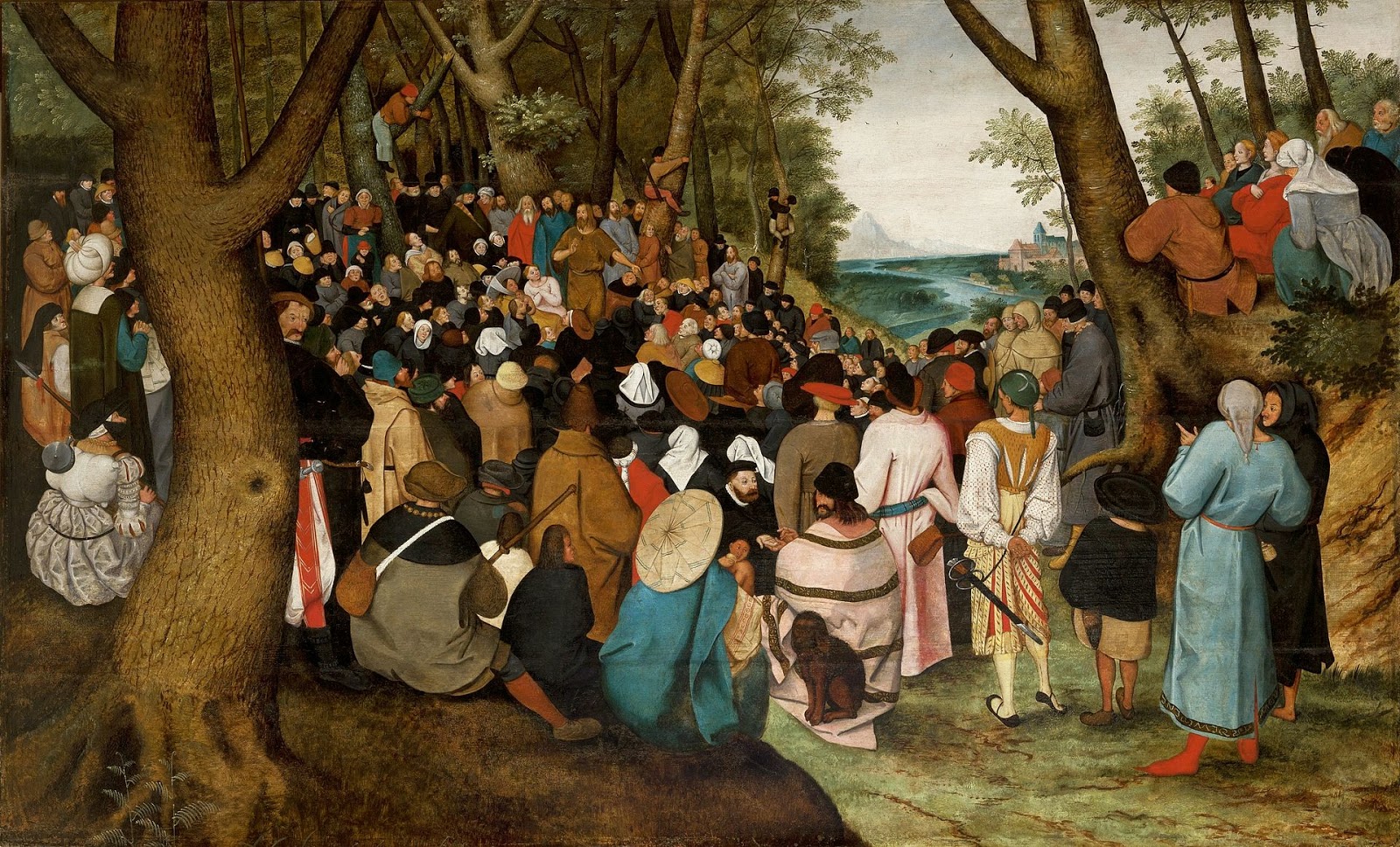 |
The Preaching of St John the Baptist, 1601 - 1604
Pieter Brueghel the Younger
|
The "in the style of Bruegel" and "Bruegel imitations" markets were served by the two Bruegel sons (working anonymously) along with other painters. The most copied of the Elder's works was Winter Landscape with Skaters and Bird Trap (1565). This work has 140 known copies, 50 of which originated from the Younger's workshop. The original and one of the copies are shown in the images immediately following.
|
Winter Landscape with Skaters and Bird Trap, 1565
Pieter Bruegel the Elder
|
 |
Winter Landscape with a Bird trap, 1620s
Pieter Brueghel the Younger
|
In my next post I will examine how Bruegel's techniques and subjects were reflected in, and propagated by, subsequent generations of painters.
©EverythingElse238
Friday, June 28, 2019
Pieter Bruegel the Elder: Evolution of his compositional and painting styles
When Pieter Bruegel the Elder visited Italy in the early 1550s, the Mannerist School was in full flower, yet, unlike many of his predecessors, he did not adopt this style in his works. Rather, according to a number of contemporary -- and near-contemporary -- commentators, he reached back into old Flemish painting approaches -- specifically the work of Hieronymus Bosch (c. 1450 - 1516) -- to serve as the foundation of his early painting style.
Some understanding of Bosch's style is a prerequisite to understanding Bruegel's style.
Boschian Style
Writing in the New Yorker, Becca Rothfield described Bosch's works thusly:
Pieter Coecke van Aelst is noted as Bruegel's teacher but there are no identified influences passed from teacher to pupil. One area of influence, however, may have been in the area of landscapes. As I noted in an earlier post, all of the works completed immediately on Bruegel's return from Italy were landscapes. And he showed himself to be an accomplished landscapist who adhered to Flemish traditions in that area. The father of Flemish landscaping was reputed to be Joachim Patinir (c. 1480 - 1524) and it is quite likely that his principles and practices were conveyed to Bruegel during his apprenticeship with Coecke van Aelst.
Patinir's painting style can be summarized as follows (Wikipedia):
Rome Period (1552 - 1553)
In the earliest surviving works Bruegel appears as a landscape artist who hews to the traditions of Patinir but also with some influence from Venetian landscape artists. In Landscape of the Alps and Mountain Landscape with a River, both efforts share steep rock outcroppings and high horizons (a la Patinir). Landscape with Christ appearing to the Disciples at the Sea of Tiberias is textbook Patinir with the rock outcroppings and the three-part color scheme: brownish shades in the foreground, bluish-green in the middle, and a pale blue background.
The Antwerp Period (1554 - 1562)
Most of Bruegel's work during his time in Antwerp was devoted to the composition of drawings for printmaking and more than 20 of the 60 drawings produced during this time drew on Boschian visuals; so much so that Big Fishes Eat Small Fishes (1556) was initially ascribed to Bosch (probably an attempt by the publisher to exact a higher price for the piece). In The Seven Deadly Sins (1558) series, "Bruegel achieved a tricky, creative synthesis of Bosch's demonic symbolism with his own personal vision of human folly and depravity." The vice of Pride from the series is displayed in the second image following.
Bosch's effect can still be seen in Bruegel's earliest signed and dated painting -- The Fight between Carnival and Lent (1559):
Bruegel's two most Bosch-like paintings are Dulle Griet and Triumph of Death, both completed in 1562, while Tower of Babel (1563) shows a "new panoramic vista of a vast world only distantly related to Bosch's cosmic landscape" and informs most of his subsequent work. This latter work also highlights the artist's attention to detail and the scientific exactness of his representations.
Brussels Period (1563 - 1569)
Bruegel moved to Brussels after his marriage to Mayken and it is in this period that he produces his best-known paintings.He returned to landscapes in a big way with a six-painting series honoring the labors associated with the months of the year. These paintings (one of which is lost) were beautifully conceived and executed with the included figures subordinated to great lines of the landscape. Return of the Herd is considered one of the most brilliant panels in the series with a sequence of intersecting diagonals illuminating the scope and grandeur of the natural world.
Distinct Italianate influences begin to emerge in the Bruegel's last works. The monumentalization of the figure in Peasant and Bird Nester (1565) has hints of the grandeur of Michelangelo while the diagonal arrangement of the figures in Peasant Wedding Feast (1566 - 67) recalls Venetian composition. These two paintings show a reduction of the number of individuals in the picture when compared to, for example, The Census at Bethlehem (1566).
Van Eyck and the other stars of the Northern Renaissance used a glaze to "glorify" their oil paintings while Bruegel, in The Census at Bethlehem, mixed layers that had not dried completely. This method is called wet on wet and its light effects are not due to transparency but rather an overlay of material and thick impasto brush strokes of color. This method was first introduced by Bosch.
Pieter Bruegel the Elder reached back into the early phases of the Northern Renaissance to leverage the fantastical works of Hieronymus Bosch and the pioneering landscape works of Joachim Patinir to form the foundation which provided a source of income in his early years and served as a launching pad for the evolution and development of his painting style. The product of his efforts led to widespread recognition and acclaim and, eventually, a noteworthy legacy. I will cover that legacy in my next post.
- In his 1567 work on the history of the Netherlands, the Italian humanist and scholar Lodovico Guicciardini reported on one Pieter Bruegel from Breda who was "a great imitator of of the science and functions of Hieronymus Bosch" so much so that he had been given the epithet of "Second Hieronymus Bosch" (Koster).
- Vasari confused the timeline of the two artists but described the works of Bosch and Bruegel as (i) landscapes in oil and (ii) fantasies, bizarre things, dreams and imaginations.
- The humanist Dominicus Lampsonius highlighted Bruegel's gift with pen and design and, in so doing, elevated his drawings over his painterly works.
- Ortelius, the famed cartographer, acknowledged both the Boschian and naturalism aspects of Bruegel's work; as did Karel van Mander in his biography of the artist.
 |
| The Census at Bethlehem, 1566 Pieter Bruegel the Elder |
Some understanding of Bosch's style is a prerequisite to understanding Bruegel's style.
Boschian Style
Writing in the New Yorker, Becca Rothfield described Bosch's works thusly:
… Bosch managed to exert an outsized influence on the religious imagery of his day. His fantastic demons, impossible amalgamations of animals, humans, monsters, and household objects had little precedent in earlier devotional art, nor in the somewhat formulaic depiction of heaven and hell that prevailed among his contemporaries. Bosch's hellscapes presented palpable pandemonium, and even his more routine works were enlivened by inventive details: winged fish with an unfriendly expression following Christ across a river; a tottering demon protruding from a funnel.In addition to the grotesque visual images -- some appropriated from initial and bas-de-page (end-of-page) paintings from medieval illustrated manuals -- Bosch's panels (Koster):
- afforded a bird's eye view;
- provided huge, steep perspectival ground planes teeming with strange figures; and
- were painted in a thin translucent painting style.
Pieter Coecke van Aelst is noted as Bruegel's teacher but there are no identified influences passed from teacher to pupil. One area of influence, however, may have been in the area of landscapes. As I noted in an earlier post, all of the works completed immediately on Bruegel's return from Italy were landscapes. And he showed himself to be an accomplished landscapist who adhered to Flemish traditions in that area. The father of Flemish landscaping was reputed to be Joachim Patinir (c. 1480 - 1524) and it is quite likely that his principles and practices were conveyed to Bruegel during his apprenticeship with Coecke van Aelst.
Patinir's painting style can be summarized as follows (Wikipedia):
- Immense vistas exhibitiing observation of naturalistic detail
- Landscape dwarfs figures
- High viewpoint with high horizon
- Consistent and effective color scheme
- Foreground dominated by brownish shades
- Middle ground a bluish green
- Background a pale blue.
Rome Period (1552 - 1553)
In the earliest surviving works Bruegel appears as a landscape artist who hews to the traditions of Patinir but also with some influence from Venetian landscape artists. In Landscape of the Alps and Mountain Landscape with a River, both efforts share steep rock outcroppings and high horizons (a la Patinir). Landscape with Christ appearing to the Disciples at the Sea of Tiberias is textbook Patinir with the rock outcroppings and the three-part color scheme: brownish shades in the foreground, bluish-green in the middle, and a pale blue background.
 |
Landscape of the Alps, 1553
Pieter Bruegel the Elder
|
 |
Mountain Landscape with a River, 1553
Pieter Bruegel the Elder
|
 |
Landscape with Christ appearing to the Disciples at the Sea of Tiberias, 1553
Pieter Bruegel the Elder
|
Most of Bruegel's work during his time in Antwerp was devoted to the composition of drawings for printmaking and more than 20 of the 60 drawings produced during this time drew on Boschian visuals; so much so that Big Fishes Eat Small Fishes (1556) was initially ascribed to Bosch (probably an attempt by the publisher to exact a higher price for the piece). In The Seven Deadly Sins (1558) series, "Bruegel achieved a tricky, creative synthesis of Bosch's demonic symbolism with his own personal vision of human folly and depravity." The vice of Pride from the series is displayed in the second image following.
 |
| Big Fishes Eat Small Fishes, 1556 Pieter Bruegel the Elder |
 |
| Pride, 1558 Pieter Bruegel the Elder |
Bosch's effect can still be seen in Bruegel's earliest signed and dated painting -- The Fight between Carnival and Lent (1559):
- High-horizoned landscape
- Decorative surface patterning
- Many iconographic details.
 |
| The Fight between Carnival and Lent, 1559 Pieter Bruegel the Elder |
 |
| Netherlandish Proverbs, 1559 Pieter Bruegel the Elder |
Bruegel's two most Bosch-like paintings are Dulle Griet and Triumph of Death, both completed in 1562, while Tower of Babel (1563) shows a "new panoramic vista of a vast world only distantly related to Bosch's cosmic landscape" and informs most of his subsequent work. This latter work also highlights the artist's attention to detail and the scientific exactness of his representations.
 |
| The Triumph of Death, c. 1562 Pieter Brueghel the Elder |
 |
| Tower of Babel, 1563 Pieter Bruegel the Elder |
Brussels Period (1563 - 1569)
Bruegel moved to Brussels after his marriage to Mayken and it is in this period that he produces his best-known paintings.He returned to landscapes in a big way with a six-painting series honoring the labors associated with the months of the year. These paintings (one of which is lost) were beautifully conceived and executed with the included figures subordinated to great lines of the landscape. Return of the Herd is considered one of the most brilliant panels in the series with a sequence of intersecting diagonals illuminating the scope and grandeur of the natural world.
 |
| The Return of the Herd, 1565 Pieter Bruegel the Elder |
Distinct Italianate influences begin to emerge in the Bruegel's last works. The monumentalization of the figure in Peasant and Bird Nester (1565) has hints of the grandeur of Michelangelo while the diagonal arrangement of the figures in Peasant Wedding Feast (1566 - 67) recalls Venetian composition. These two paintings show a reduction of the number of individuals in the picture when compared to, for example, The Census at Bethlehem (1566).
 |
| The Peasant and the Bird Nester, 1568 Pieter Bruegel the Elder |
 |
| Peasant Wedding Feast, 1566 - 67 Pieter Bruegel the Elder |
Van Eyck and the other stars of the Northern Renaissance used a glaze to "glorify" their oil paintings while Bruegel, in The Census at Bethlehem, mixed layers that had not dried completely. This method is called wet on wet and its light effects are not due to transparency but rather an overlay of material and thick impasto brush strokes of color. This method was first introduced by Bosch.
Pieter Bruegel the Elder reached back into the early phases of the Northern Renaissance to leverage the fantastical works of Hieronymus Bosch and the pioneering landscape works of Joachim Patinir to form the foundation which provided a source of income in his early years and served as a launching pad for the evolution and development of his painting style. The product of his efforts led to widespread recognition and acclaim and, eventually, a noteworthy legacy. I will cover that legacy in my next post.
Bibliography
Joseph Leo Koster, In Love with Multiplicity, New York Review of Books, May 23, 2019.
Nadine M. Orenstein, The Elusive Life of Pieter Bruegel the Elder in Nadine M. Orenstein (ed.), Pieter Bruegel the Elder: Drawings and Prints, Metropolitan Museum of Art, Yale University Press, 2001.
Becca Rothfield, Hieronymus Bosch's Five-Hundredth-Anniversary Homecoming, New Yorker, March 24, 2016.
Martin Royalton-Kisch, Pieter Bruegel as a Draftsman: The Changing Image in Nadine M. Orenstein (ed.), Pieter Bruegel the Elder: Drawings and Prints, Metropolitan Museum of Art, Yale University Press, 2001.
©EverythingElse238
Tuesday, June 25, 2019
Pieter Bruegel the Elder: Life Overview
"There has never been a better painter than Bruegel," according to Joseph Leo Koster. "Always flawless in his design and execution, yet different in each of his works, the peerless painter of the low-life genre yet attaining a monumental vision of the whole, a virtuoso in the ways he manipulates paint yet never contrived, he makes his only rivals (Jim van Eyck, Titian, and Velázquez) seem limited, repetitive, or artificial by comparison." According to metmuseum.org, "Bruegel brought a humanizing spirit to traditional subjects and boldly created new ones. He was an astoundingly innovative painter and craftsman" whose "impact was widespread and long lasting."
Little is known about Bruegel's birth or early life. One of his early biographers lists his place of birth as Breda while another lists it as a town near Breda named Brueghel. No such town has been located.
His biographers place Bruegel under the tutelage of the Antwerp-based painter Pieter Coecke van Aelst (who died in 1550 and whose younger daughter Mayken would eventually become Bruegel's wife). There is concrete evidence that Bruegel was in Mechelen in 1550 and 1551 in the employ of the artist and art dealer Claude Dorize. Dorize had a contract with the glove makers' guild to paint an altarpiece for emplacement in Saint Rombout Cathedral and had secured the services of Peeter Baltons to paint the main panel and Bruegel to paint the wings in grisaile. Coecke's wife was originally from Mechelen so it is conceivable that she was instrumental in Bruegel getting this commission. He joined the Antwerp painters guild in 1551 after completion of the Mechelen effort (Orenstein).
Bruegel traveled to Italy between 1552 and 1554. He crossed over to the peninsula from Lyon, traveling as far south as Sicily before finally making his way to Rome, where he sojourned for a while. It is hypothesized that he made this journey in the company of two Antwerp artists: the painter and print designer Maarlen de Vos and the sculptor Jacob Jongelinck.
Bruegel's earliest works show that he was an accomplished landscapist prior to embarking on his trip to Italy (Royalton-Kisch). The drawings for River Landscape and Southern Cloister in a Valley are viewed as based on in-situ drawings while the Naval Battle in the Strait of Messina, while showing a later date, is probably also based on drawings made while he was in Sicily. River Landscape and Southern Cloister in a Valley both show extraordinary variety of touch while the former serves up "broad, empty expanses of river and open sky" (Royalton-Kisch).
In Rome Bruegel met and collaborated with the Croatian miniaturist Giulio Clovio whose estate inventory included a number of works done by the Flemish artist during his sojourn. One of these works was a miniature painted in equal parts by the two artists. The location of the Bruegel works that were in the possession of Clovio are unknown today.
In 1554 Bruegel returned to Antwerp and began working with Hieronymus Cock, one of the best-known print publishers in the Antwerp market at that time. His first effort was Landscape with Bears which Cock elaborated and etched as Landscape with the Temptation of Christ.
In the 1555-56 timeframe, Bruegel developed the designs for the Large Landscapes group of prints, the beginning of a very productive period as a designer of prints. Extending until 1561, this period yielded more than 40 drawings and provided a steady source of income for the young artist. In the same timeframe he completed four paintings:The Parable of the Sower (1557), The Netherlandish Proverbs (1559), The Battle between Carnival and Lent (1559), and The Children's Games (1560)
Bruegel becomes increasingly active as a painter in 1562, producing the bulk of his known paintings between this year and his death in 1569.
He married Mayken in 1563 and moves to Brussels. There is some conjecture as to why a painter coming into his own would move from the financial center (and wealthy patrons) in Antwerp to the seat of government in Brussels but, in the end, it worked out for him. His patrons included:
Bruegel did not publish any writings or descriptions of his work that would either assist in their interpretation or provide insight into his religious or political beliefs. The Low Countries were in the midst of a major religious conflagration between the Calvinists and the Catholics, with the Duke of Alva on the hunt for any and all heretics, yet none of this clearly shows through in his works. In the few drawings and prints which can be categorized as religious, his Tower of Babel is more an allegory "of human pride than a representation of the story in Genesis." In New Testament works, he "showed little interest in depicting Christ's life as reported in the Gospels; instead, he favored the parables uttered by Christ."
I will examine the evolution of Bruegel's style in my next post.
Bibliography
Joseph Leo Koster, In Love with Multiplicity, New York Review of Books, May 23, 2019.
Nadine M. Orenstein, The Elusive Life of Pieter Bruegel the Elder in Nadine M. Orenstein (ed.), Pieter Bruegel the Elder: Drawings and Prints, Metropolitan Museum of Art, Yale University Press, 2001.
Martin Royalton-Kisch, Pieter Bruegel as a Draftsman: The Changing Image in Nadine M. Orenstein (ed.), Pieter Bruegel the Elder: Drawings and Prints, Metropolitan Museum of Art, Yale University Press, 2001.
©EverythingElse238
 |
| Pieter Bruegel the Elder |
Little is known about Bruegel's birth or early life. One of his early biographers lists his place of birth as Breda while another lists it as a town near Breda named Brueghel. No such town has been located.
His biographers place Bruegel under the tutelage of the Antwerp-based painter Pieter Coecke van Aelst (who died in 1550 and whose younger daughter Mayken would eventually become Bruegel's wife). There is concrete evidence that Bruegel was in Mechelen in 1550 and 1551 in the employ of the artist and art dealer Claude Dorize. Dorize had a contract with the glove makers' guild to paint an altarpiece for emplacement in Saint Rombout Cathedral and had secured the services of Peeter Baltons to paint the main panel and Bruegel to paint the wings in grisaile. Coecke's wife was originally from Mechelen so it is conceivable that she was instrumental in Bruegel getting this commission. He joined the Antwerp painters guild in 1551 after completion of the Mechelen effort (Orenstein).
Bruegel traveled to Italy between 1552 and 1554. He crossed over to the peninsula from Lyon, traveling as far south as Sicily before finally making his way to Rome, where he sojourned for a while. It is hypothesized that he made this journey in the company of two Antwerp artists: the painter and print designer Maarlen de Vos and the sculptor Jacob Jongelinck.
Bruegel's earliest works show that he was an accomplished landscapist prior to embarking on his trip to Italy (Royalton-Kisch). The drawings for River Landscape and Southern Cloister in a Valley are viewed as based on in-situ drawings while the Naval Battle in the Strait of Messina, while showing a later date, is probably also based on drawings made while he was in Sicily. River Landscape and Southern Cloister in a Valley both show extraordinary variety of touch while the former serves up "broad, empty expanses of river and open sky" (Royalton-Kisch).
 |
| River Landscape, 1552 Pieter Bruegel the Elder |
 |
| Southern Cloister in a Valley, engraving, 1552 After Pieter Bruegel the Elder |
 |
| Wooded Landscape with Mills, 1552 Pieter Bruegel the Elder |
 |
| Pastoral Landscape, 1552 Pieter Bruegel the Elder |
 |
| Mountain Landscape with Ridge and Valley, 1552 Pieter Bruegel the Elder |
 |
| Naval Battle in the Strait of Messina, engraving, 1561 After Peter Bruegel the Elder |
In Rome Bruegel met and collaborated with the Croatian miniaturist Giulio Clovio whose estate inventory included a number of works done by the Flemish artist during his sojourn. One of these works was a miniature painted in equal parts by the two artists. The location of the Bruegel works that were in the possession of Clovio are unknown today.
 |
| Ripa Grande in Rome, 1552 - 1554 Pieter Bruegel the Elder |
In 1554 Bruegel returned to Antwerp and began working with Hieronymus Cock, one of the best-known print publishers in the Antwerp market at that time. His first effort was Landscape with Bears which Cock elaborated and etched as Landscape with the Temptation of Christ.
 |
| Landscape with the Temptation of Christ, 1554 After Pieter Bruegel the Elder |
In the 1555-56 timeframe, Bruegel developed the designs for the Large Landscapes group of prints, the beginning of a very productive period as a designer of prints. Extending until 1561, this period yielded more than 40 drawings and provided a steady source of income for the young artist. In the same timeframe he completed four paintings:The Parable of the Sower (1557), The Netherlandish Proverbs (1559), The Battle between Carnival and Lent (1559), and The Children's Games (1560)
Bruegel becomes increasingly active as a painter in 1562, producing the bulk of his known paintings between this year and his death in 1569.
He married Mayken in 1563 and moves to Brussels. There is some conjecture as to why a painter coming into his own would move from the financial center (and wealthy patrons) in Antwerp to the seat of government in Brussels but, in the end, it worked out for him. His patrons included:
- Cardinal Antoine Perrenot de Granville
- Nicolas Jongelinck, prominent Antwerp merchant and royal official (owned 16 of Bruegel's works
- Abraham Ortelius, cartographer.
Bruegel did not publish any writings or descriptions of his work that would either assist in their interpretation or provide insight into his religious or political beliefs. The Low Countries were in the midst of a major religious conflagration between the Calvinists and the Catholics, with the Duke of Alva on the hunt for any and all heretics, yet none of this clearly shows through in his works. In the few drawings and prints which can be categorized as religious, his Tower of Babel is more an allegory "of human pride than a representation of the story in Genesis." In New Testament works, he "showed little interest in depicting Christ's life as reported in the Gospels; instead, he favored the parables uttered by Christ."
 |
| The Tower of Babel, c. 1563 Pieter Bruegel the Elder |
 |
| The Parable of the Wise and Foolish Virgins, 1560 - 63 After Pieter Bruegel the Elder |
 |
| The Parable of the Good Shepherd, 1565 After Pieter Bruegel the Elder |
I will examine the evolution of Bruegel's style in my next post.
Bibliography
Joseph Leo Koster, In Love with Multiplicity, New York Review of Books, May 23, 2019.
Nadine M. Orenstein, The Elusive Life of Pieter Bruegel the Elder in Nadine M. Orenstein (ed.), Pieter Bruegel the Elder: Drawings and Prints, Metropolitan Museum of Art, Yale University Press, 2001.
Martin Royalton-Kisch, Pieter Bruegel as a Draftsman: The Changing Image in Nadine M. Orenstein (ed.), Pieter Bruegel the Elder: Drawings and Prints, Metropolitan Museum of Art, Yale University Press, 2001.
©EverythingElse238
Subscribe to:
Posts (Atom)
In the Footsteps of Piero della Francesca: Queen of Sheba, King Solomon, and Burial of the Wood
Just below the Death of Adam in Basilica di San Francesca's Bacci Chapel is the two-scene fresco Procession of the Queen of Sheba and M...

-
 With the death of Charles the Bold in 1477, many of the early Netherlandish painters lost the main source of their patronage. Further, their...
-
 The recent Caravaggio 2025 Exhibition at Palazzo Barberini in Rome curated the offerings on show into four major categories:(i) Making a Na...
-
 I was unfamiliar with the Museum of Art - Deland; that is, until I read an online article touting the quality of their staff -- of all thing...