Wednesday, December 9, 2020

The roots of the anti-Mannerist, proto-Baroque, Bolognese School (1590 - 1630)

The Council of Trent (1545 - 1563), in its attempts to blunt the effects of the Protestant Reformation, issued a number of decrees, including one which welcomed religious imagery as an aid in religious teaching. According to witcombe.sbc.edu, the religious imagery employed in this manner was expected to exhibit:

  • Clarity, simplicity, and intelligibility 
  • Realistic interpretation
  • Emotionally stimulate piety.
While the church was open to the use of painted works to communicate religious messages to the masses, it did not conceive of the then-dominant painting style -- Mannerism -- as being up to the task. Post-1550 Mannerism exhibited (witcombe.sbc.edu):

  • Virtuosity of execution and highly decorative surface qualities go with compositional decentralization and spatial and coloristic complexities
  • Deliberate physical and psychic ambiguities puzzle the beholder
  • Intricacies of handling are often matched by the intricacies of content
  • Many pictures and fresco cycles of the period are obscure and esoteric 
  • Little power to stir religious emotions in the mass of the faithful
  • Lacked clarity, realism, and emotional intensity.
The images below show the difference between Correggio's Noli Me Tangere -- done in the High Renaissance style -- versus the Mannerist representation by Bronzino. 

Noli me Tangere, c. 1525
Antonia da Correggio

Noli me Tangere, 1561
Agnolo Bronzino

Painting in the Late Mannerist style (1550 - 1580) represented "an extraordinary decline in quality" from the High Renaissance. The movement which stepped into the breach was the Bolognese School (c.1590 - 1630), an "anti-Mannerist" art movement founded by the Bolognese-based Carracci family. "Ludovico Carracci and his cousins led the charge in the greatest reform of artistry since Cimabue and Giotto, and the first reactionary art Revolution in Western Art History" (The Carracci and Caravaggio Revolution: Foundations of the Baroque, forums.civfanatics.com). Lets take a look at the family and the fruits of their activities.

The Carracci
Ludovico was the oldest of the trio that included him and his two cousins: Annabile and Agostino. Ludovico was initially apprenticed to the painter Prospero Fontano who, after some time, sought to dissuade him from pursuing that career track because he did not "have the nature for it." Ludovico was not dissuaded, however, and went off to study on his own, traveling through North and Central Italy to study the works of Renaissance painters such as Andrea del Sarto (Florence), Parmagiannino (Parma), Giulio Romano (Mantua), and Titian and Tintoretto ( Enice).

Annibale Caracci's father was a tailor in Bologna. Due to the family's financial circumstances, Annibale was forced to leave school at the age of 11 to begin an apprenticeship with a goldsmith. His training while there included learning to draw and it soon became apparent that he was very talented; so much so that his apprenticeship was switched to the Mannerist painter Bartolomeo Passerotti.

In 1580, Annibale took off on a study tour of northern Italy, stopping in Correggio's studio in Parma and then moving on to Venice where he met up with his brother Agostino. In Venice they studied the works of the painters Titian, Veronese, Giorgione, and Tintoretto and marveled at their mastery of color and light. 

Agostino also started out as a goldsmith's apprentice but turned to painting and was trained, initially, by Prospero Fontano, and then by Passerotti and Domenico Tibaldi. He worked as a reproductive engraver in the late 1570s and visited Venice and Parma in the 1580s before returning to Bologna to aid in the founding of the Carracci Academy.

The Carracci Academy
The Carracci brothers returned to Bologna and collaborated with their cousin Ludovico in the formation of an academy focused on teaching art. The Carracci used the academy to "promote the idea that art should draw directly from nature for its study," and idea that was a direct refutation of Mannerism's focus on complexity and artificiality. The genesis of the school is illustrated in the chart below.

The key innovation for the Carracci was the melding of the design characteristics of Florentine art with the colors of Venetian art and their naturalism into a style that was characterized by clear, simple, direct imagery. This style comported well with the guidelines established by the Council of Trent and was enthusiastically endorsed in Rome. It is thus no coincidence that the Carracci came to dominate the religious art scene and their works began to show up in many churches, chapels, and cathedrals.

They worked together on the Palazzo Fava in 1583 and the Palazzo Magnani in 1590-92. In 1594 Cardinal Farnese invited Annibale to Rome to work on Palazzo Farnese and commissioned him in 1597 to work on the frescoes for the Gallery. He was joined by Agostino for this effort.


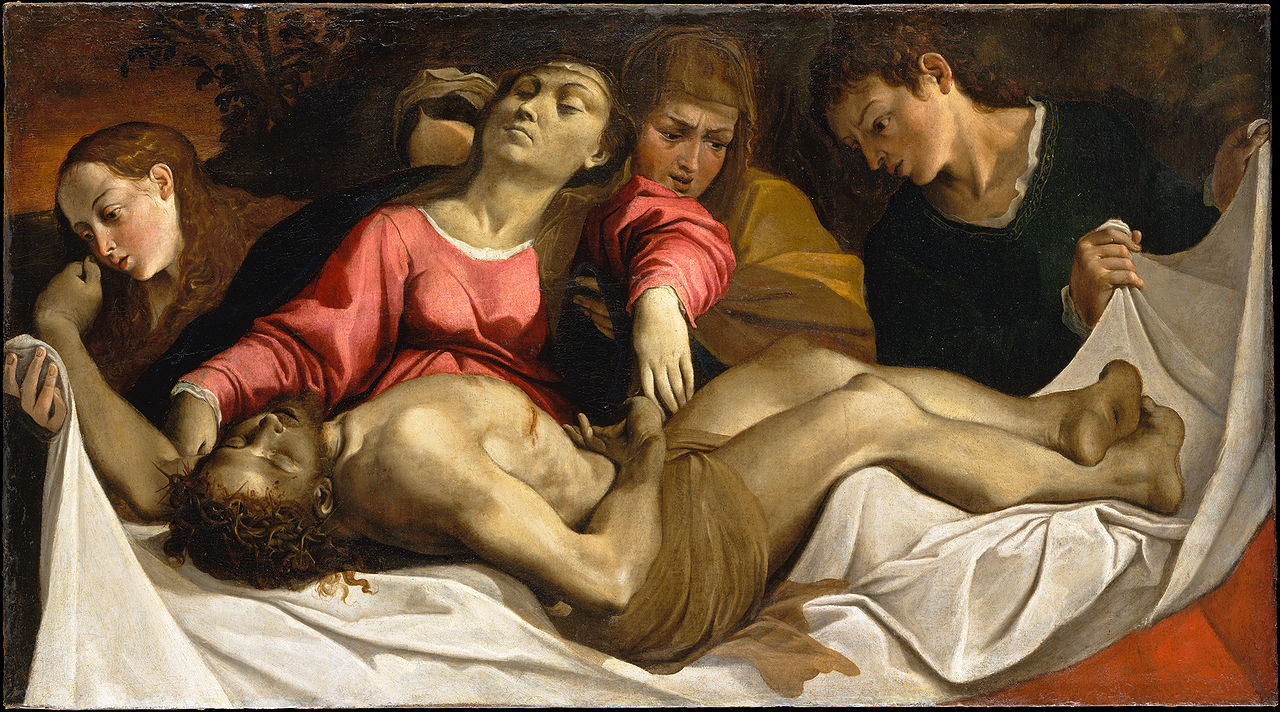
Lamentation of Christ, c. 1582
Ludovico Carracci

Annunciation
Ludovico Carracci

Madonna and Child with Saints, 1586
Agostino Carracci

The Lamentation, 1586
Agostino Carracci

The Butcher’s Shoo, 1583
Annibale Carracci

The Bean eater, 1580 - 1590
Annibale Carracci

Rest on the Flight into Egypt, 1600
Annibale Carracci

Pieta, 1599 - 1600
Annibale Carracci

Landscape with Flight into Egypt, 1604
Annibale Carracci

In his trial in Rome, Caravaggio identified Annibile as one of the 10 best artists in Rome at that time. And it is easy to see why. in addition to his life studies and drawings, Annibale was accomplished in frescoes, a style that evaded Caravvagio. In addition, Annabelle was accomplished in genre scenes and landscapes.

In future posts I will explore the Farnese Gallery frescoes, the legacy of the Carraccis, and the role of the Carracci students in the overall influence and impact of The Bolognese School.


©EverythingElse238

Saturday, November 28, 2020

Catholic Counter-Reformation Art (1560 - 1700)

The Catholic Church had been set back on its heels by the Protestant Reformation -- the "16th-Century religious, political, intellectual, and cultural upheaval that splintered Catholic Europe" (history.com) -- and responded with the Council of Trent (1545 - 1563) and its decrees countering the Reformist agenda.


One of the areas addressed by the Council was art and its role in Catholic Christian life. The dominant style of art at that time was Mannerism but Catholic leaders found this style to be lacking in pious appeal. Religious art of the time, according to the Church:
  • Had lost its focus on religious subject matter
  • Was too much focused on decorative qualities 
  • Was too influenced by classical pagan art.
Examples of this diminished focus on religious subjects, and elevation of style, are demonstrated in Parmigianino's Madonna of the Long Neck and Pontormi's The Deposition.

Madonna of the Long Neck
Parmigianino, 1530 - 33

The Deposition from the Cross
Jacopo Pontormi, 1525 - 28

Michelangelo's The Last Judgement "... came under persistent attack in the Counter-Reformation for, among other things, nudity (later painted over for several centuries), not showing Christ seated or bearded, and including the pagan figure of Charon" (Wikipedia).

The Last Judgment, 1534 - 41
Michelangelo

The interpretations of the art-related dictates issuing from the Council of Trent were as follows:

  • Art was to be direct and compelling in its narrative presentation
  • It was to provide an accurate presentation  of the biblical narrative of the saints' lives, rather than adding anecdotal and imaginary moments
  • It was the duty of all painters to proclaim and explain the truths of the Catholic religion.

Scipione Pulzone's Lamentation was viewed as a work that gave "a clear demonstration of what the holy council was striving for in the new style of religious art ... the focus of the painting giving direct attention to the crucifixion of Christ, it complies with the religious content of the of the council and shows the story of the passion while keeping Christ in the image of the ideal human" (Wikipedia).

Lamentation, 1589
Scipione Pulzone

The Church, the newly formed Jesuits, and wealthy individuals began commissioning works to support this new direction and were provided strong support in Italy, Spain and its colonies (Flanders and Naples), and southern Germany. This new direction is reflected beginning with the efforts of the Bolognese School which itself became a forerunner of the Baroque. I will cover The Bolognese School in my next post on this topic.

©EverythingElse238

    Sunday, November 15, 2020

    Orazio Gentileschi: The life and art of a transitory Carravagiste

    In an earlier piece on this blog I detailed how the Caravaggisti thread flowed through Italian adherents to Utrecht, carried there by Dutch painters returning from sojourns in Rome. In this series, I will cycle back to the Italian Caravaggistis, beginning with Orazio Gentileschi.

    Portrait of Orazio Gentileschi, c. 1630
    Lucas Emil Vorsterman after Sir Anthony van Dyck

    Orazio was born in Pisa in 1563, son to a Florentine Goldsmith named Giovanni Battista Lomi. He moved to Rome in either 1576 or 1578 and took up residence with a maternal uncle whose surname -- Gentileschi -- he adopted.

    There is no widely accepted account as to how Orazio acquired his painting skills. His first mention as a painter was as part of a team of artists decorating the Vatican Library in the period 1588 - 1589. He subsequently worked with the landscape painter Agostino Tassi painting frescos in the churches of Santa Maria Maggiore, San Giovanni Laterano, and Santo Nicolosi in Carcere. This work ran from 1590 - 1600 and Orazio probably contributed figures for Tassi's landscapes.

    During this period Orazio was considered a "competent but undistinguished practitioner of the dominant late maniera style."

    San Giovanni dei Fiorentino --Interior 
    Attributed to Orazio Gentileschi

    San Giovanni dei Fiorentino --Interior 
    Attributed to Orazio Gentileschi

    Exposure to Caravaggio's works led to major changes in Orazio's life and painting styles. According to Keith Christiansen and Judith W. Mann (Orazio and Artemisia Genteleschi, Metropolitan Museum of Art, NY, 2001):

    Orazio's encounter with Caravaggio in the summer of 1600 was the central event of his life. Prior to the unveiling of Caravaggio's canvases showing the calling and martyrdom of Saint Matthew (ed., see below) in the French national church of San Luigi dei Francesi, which created a sensation by making the Lombard artist's work publicly visible for the first time, Orazio had painted in a style that was predicated on compromise and accommodation. His figures were types, his composition conventional; his color was slack. There is a blandness, an anonymity, and a disturbing lack of conviction to his work of the 1590s that comes (sic) as a shock to those who know only his distinctive, post-Caravaggesque pictures.

    The Calling of St Matthew, 1599-1600
    Caravaggio

    The Martyrdom of St. Matthew, 1599-1600
    Caravaggio

    Orazio became a close associate of Caravaggio, and "unexpected and bold" development in that he was married, the father of four kids, and, at 37 years of age, 11 years older than the oldest of the followers. That being said, his paintings post-1600 began to incorporate elements of the Caravaggio approach (NGA, Christiansen and Mann):

    • Use of models
    • Dramatic lighting
    • Simplified compositional structures with a restricted number of figures close to the picture plane
    • Use of dramatic, unconventional gestures and monumental composition
    • Uncompromising realism and contemporary representation of figure types.
    In the paintings immediately following, Orazio's movement away from Mannerism and incorporation of Caravaggic elements are on full display.

    St Francis supported by an Angel, c. 1603
    Orazio Gentileschi

    David and Goliath, 1605 - 1607
    Orazio Gentileschi

    Circumcision of Christ, c. 1605 - 1610
    Orazio Gentileschi

    St Michael and the Devil, 1607 - 1608
    Orazio Gentileschi

    R. Ward Bissel (Bulletin of the Detroit Institute of Arts, 1967) saw the foregoing paintings as Orazio seeking to find his own way of expressing Caravaggism: "Having explored these alternatives, Gentileschi chose to work towards increased refinement of sentiment and of pictorial effects, and, in so doing established himself as the most original painter among the Roman Caravaggeschi."  Young Woman with a Violin characterizes this moment. It is pure Caravaggio in the placement of a single figure against a dark background with the individual illuminated by an intense light.

    Young Woman with a Violin, c. 1612
    Orazio Gentileschi

    It was during this period that Orazio formed a relationship with the painter Agostino Tassi to collaborate on the frescos in the Casino delle Muse for Cardinal Scipione and in the Sala del Consistorio in the Quirinale Palace. The partnership came to a scandalous end when Orazio accused Tassi of "deflowering" his daughter (and student) Artemisia.

    Following the scandal, Orazio actively began seeking work outside of Rome. This led to commissions in Fabriano in 1616-17 and he then accepted the invitation of a Genoese nobleman to work for him in that city. He resided in Genoa from 1621 - 1623. Post that period he became primarily a court painter, traveling to Paris to work with the court of Marie de Medici (1624 - 1626) and then on to the court of Charles I in London. He died in London in 1639.

    Somewhere around 1615 his painting style also changed. According to the National Gallery of Art, he "developed a Tuscan lyricism foreign to Caravaggio's almost brutal vitality" and this was reflected in a lighter palette and a more precise treatment reminiscent of his Mannerist beginnings. In the NGA article, Sydney Freedberg is quoted thusly: "Orazio passed beyond dependence on the art of Caravaggio into a powerful and highly personal style, for which the prior assimilation of Caravaggio was a threshold." His masterpiece -- Annunciation -- was created during this post-Caravaggio period.

    Annunciation, c. 1623
    Orazio Gentileschi

    Even though Orazio backslid, he still enjoys special prominence when discussions arise re Caravaggisti active in the first two decades of the 17th century. He was the first to respond to the shift but he also influenced others, notably Bartolomeo Lavarozzi (1590 - 1625), Orazio Riminaldi (1593 - 1630), and Giovann Francesco Guerreiri (1589 - 1655/1659), Italians all. He also influenced Hendrik Terbruggen who the took the style back to Utrecht. But, by far, his most prominent student was his daughter Artemisi who I will cover in my next post in this series.

    ©EverythingElse238

    Wednesday, September 23, 2020

    The Utrecht Caravaggists

    Earlier Low-Country art movements such as the Romanists and Haarlem Mannerists resulted from local artists traveling to Rome and bringing back their learnings to their home markets. Such also was the case for Utrecht Caravaggism, the subject of the current post. I have laid the foundation with earlier posts on Caravaggio and Caravaggism.

    Utrecht
    At 40% Catholic in the middle of the 17th Century, Utrecht was the most Catholic of the cities in the United Provinces. And that percentage was even higher if only the elite were evaluated. The city was, however, a key part of a Protestant republic and played important roles in both the Dutch War of Independence (1568 - 1648) and the Thirty-Year War (1618 - 48).

    With the resumption of hostilities between the Dutch Republic and Spain, Utrecht was a city in turmoil. In addition to the never-ending troop movement, the religious authorities clamped down on the city's 30,000 inhabitants, forbidding:
    • Public celebration of Catholic feast days
    • Dancing
    • Loud music in taverns and homes
    • Drinking
    • Gambling
    • Sports and games
    • Gathering of unmarried youth
    Utrecht Caravaggism
    This "painting school" encompasses those Dutch Baroque artists who were influenced by Caravaggism while in Rome in the 1610s and upon their return to Utrecht, developed works in the Caravaggisti style. Key players in this drama were Hendrick ter Brugghen, Dirck van Baburen, and Gerard van Honthorst.  

    They became known as Caravaggisti because they adopted Caravaggio's:
    • Strong sense of light
    • Dramatic contrast between light and dark
    • Focus on emotionally charged subject matter.
    Hendrick ter Brugghen
    Hendrick ter Brugghen began to study painting in the studio of Abraham Bloemaert at the age of 13. At 15, he travelled to Italy, returning to Utrecht in 1614 (It is thought that he made a second trip to Italy in the 1620/1621 timeframe.). In Rome, ter Brugghen came into contact with, and was influenced by, the paintings of Caravaggio. On his return to Utrecht he painted in the studio of Gerrit van Honthhorst who became one of his key collaborators in standing up this new painting style.

    Hendrick ter Bruggen
    P. Bodart

    Ter Brugghen painted genre scenes of musicians and drunks as well as biblical and mythological scenes. He came to be known as the leading painter in the group and this was reflected in the commissions that came his way as well as the adulation that he received from fellow painters. Rubens famously described his work as "... above that of all the other Utrecht artists."

    A selection of his works are presented below.

    Unequal Couple, c. 1623
    Hendrick ter Bruggen

    Esau Selling his Birthright, 1625
    Hendrick ter Bruggen


    The Concert, 1627
    Hendrick ter Bruggen

    Dirck van Baburen
    Dirch van Baburen (1595 - 1624) studied painting in Utrecht under the watchful eye of the "competetnt academic artist" Paulus Moreelse and then spent the years between 1612 and 1620 in Italy. Van Baburen did have some success in Italy but much of the work that he did hewed closely to the Caravaggio line. For example, see van Baburen's The Entombment when compared with Caravaggio's.

    The Entombment, 1601 - 1604
    Caravaggio

    The Entombment, 1617
    Dirck van Baburen

    Van Baburen returned to Utrecht in 1620 and shared a studio a studio with ter Bruggen from 1622 to 1623. The continuing influence of Caravaggio on his style, especially in the use of light and shadow, is illustrated in his painting Crowning of Jesus Christ with Thorns.

    Crowning of Jesus Christ with Thorns, 1622
    Dirck van Baburen

    He was especially fond of genre scenes (see The Procuress, below) and Caravaggio's zoom-in effect, portraying half-length subjects filling the picture also inspired Baburen's dramatic compositions.

    The Procuress, after 1623
    Dirck van Baburen

    Man Playing a Jew's Harp, 1621
    Dirck van Baburen

    He was the least known of the Caravaggistis but his pictures appear in the background of two Vermeer paintings: Lady Seated at a Virginal and The Concert.

    Lady Seated at a Virginal, 1670 - 72
    Johannes Vermeer

    The Concert, 1665 - 66
    Johannes Vermeer

    Gerrit van Honthorst
    Like Hendrick ter Brugghen, Gerrit van Hanthorst (1592 - 1656) was trained in the studio of Abraham Bloemaert.

    Gerrit van Honthorst

    He went to Italy and, while there, "copied the naturalism and eccentricities" of Caravaggio. While working there he earned the moniker Gerard of the Night Scenes due to his proclivity for painting night scenes, many lit by a single candle whose direct flame was obscured form the viewer by one of the models.

    The Procuress
    Gerrit van Honthorst

    He came back to Utrecht in 1620 where he set up a studio which did very well. Ter Brugghen painted out of this studio for a couple of years.

    According to rijksmuseum.nl, "Honthorst's works are numerous, and amply represented in English and Continental galleries. His most attractive pieces are those in which he cultivates the style of Caravaggio, those, namely, which represent taverns, with players, singers and eaters. He shows great skill in reproducing scenes illuminated by a single candle, amply employing the style of chiaroscuro."

    The Concert, 1623
    Gerrit van Honthorst

    Soon after his return to Utrecht, van Honthorst abandoned the Caravaggiste style for a "much lighter palette" and went on to gain great renown for his portraits for the Royal and noble families of Europe.

    Legacy
    These painters were active in isolation in Utrecht and their very un-Dutch works were overlooked for a very long time. For example, ter Brugghen was really only recognized as a great painter in the middle of the 20th-century and is nowadays regarded as the most important of the three.

    In general there is more interest in these painters and their movement because:
    • There is now a realization that they formed an important link between Caravaggio's Italian Baroque and Dutch painters such as Rembrandt (clair-obscur), Fran Hals (genre pieces), and Vermeer (use of color).
    • They set the tone for later artists who were inspired by Caravaggio, artists such as Georges de la Tour (Lorraine) and Jan  Janssen.
    ©EverythingElse238

    Friday, September 18, 2020

    From Caravaggio to the Utrecht Caravaggisti

     I am in the midst of a series of Smithsonian lectures on the life and works of Johann Vermeer and was intrigued to learn that the works of the Utrecht Caravaggisti "forms a link connecting Caravaggio's Baroque Italian art with the great and famous painters of the Dutch Golden Age," to include Hals, Rembrandt, and the aforementioned Vermeer.  I was unfamiliar with this thread so I thought I would pull on it for a bit.

    I began by setting the foundation with a post -- based largely on a Dr. Rocky Ruggiero lecture -- on the life and works of Caravaggio. I continue in this post by establishing the linkage between Caravaggio and the Utrecht Caravaggisti.

    Caravaggio had been too busy getting into trouble and running from the law -- and developing phenomenal works of art during the dead periods --to establish a school or to take on students. Rather, subsequent adherence to his style was organic.

    According to worldatlas.com, "Caravaggisti art refers to an artistic movement that resulted in a new Baroque painting style" based on the work of Caravaggio and characterized by the use of tenebrism ("the use of profound shadowing and high contrast between areas of light and dark") and chiaroscuro (use of "light and shadows to create a three-dimensional appearance").

    The painters who adopted Caravaggio's techniques were called Caravaggisti. Some adopted his techniques for a portion of their careers while others devoted their entire lives to modeling his style. 

    The chart below shows the elements of Caravaggio's style in the southwestern quadrant and its further spread along the bottom portion. Style adherents are shown in the upper portions of the chart.


    Selected works of a subset of these non-Utrecht Caravaggisti are shown below.

    Tavern Scene with a Lute Player
    (Chiaroscuro)
    Bartolomeo Manfredi

    Saint Cecilia and the Angel, c. 1610
    (Tenebrism)
    Carlo Saraceni


    Repenting Magdalene, c. 1635 - c. 1637
    (Tenebrism)
    Georges de La Tour


    David with the Head of Goliath, 1635
    (Tenebrism)
    Bernardo Strozzi


    St. Andrew, c. 1631
    (Tenebrism)
    Jose de Ribera

    Lucretia, 1620
    (Tenebrism)
    Artemesia Gentileschi

    A number of Dutch artists were in Rome in the 1610s at a time when Caravaggio's style was influential. This group included names such as :
    • Hedrich Ter Bruggen
    • Dirck van Baburen
    • Gerst van Honthorst
    • Jan van Bijlert
    • Matthias Stom
    These painters returned to Utrecht and began painting in the Caravaggist style, earning the moniker Utrecht Caravaggisti. I will discuss these men and their works in a follow-up post.

    ©EverythingElse238

    In the Footsteps of Piero della Francesca: Meetup and the Maddalena

    Piero della Francesca's import to pre-Renaissance art and how I became involved in a trip to walk in his footsteps have previously bee...