Wednesday, August 31, 2022

Art of prehistoric and Predynastic Egypt

I have earlier provided an overview of the origins, timeline, and examples of prehistoric art but, due to the importance of Egyptian art in the development of Greek and Roman art, a detour into Egyptian art of this period is warranted.

According to metmuseum.org, "In Egypt, millenia before the advent of powerful dynasties and wealth-laden tombs, early settlements are known from modest scatters of stone tools and animal bones at such sites as Wadi Kubbaniya."

"The Predynastic Period of Ancient Egypt corresponds to the late Neolithic and covers the cultural and social changes which occurred between the late Paleothic period and the early Pharonic era" (thoughtco.com). Prior to the Predynastic, however, there were Paleolithic and Neolithic groups stretching back thousands of years. Both the prehistoric and Predynastic periods are divided into cultural eras, each named after the place where a certain type of Egyptian settlement was first discovered. The chart below shows the various cultures that are included in the two periods.


"During the Predynastic Period, Egyptians developed a written language ... and institutionalized religion. They developed  a settled agricultural civilization along the fertile dark soils of the Nile (which involved the revolutionary use of the plough) during a period in which Northern Africa was becoming arider and the edges of the Western (and Saharan) desert spread" (thoughtco.com). Also during this period, "ceramic figurines, mace heads, and other artifacts such as slate palettes used for grinding pigments, begin to appear, as does imagery that will become iconic during the Pharonic era ... " (Calvert, et al., Smarthistory guide to Ancient Egyptian art, Smarthistory, 2019.)

Examples of art of this period are depicted in the chart below.


@Everythingelse238

Monday, August 8, 2022

Piet Mondrian: The factors influencing his move from Amsterdam to Paris

The paintings Piet Mondrian executed upon his return to Amsterdam from Brabant in 1905 differed from contemporary Netherlands art in that it had "a pronounced rythmic framework and a compositional structure rather than toward the traditional picturesque values of light and shade," but between 1905 and 1911, he would be subjected to a number of experiences that would further influence his painterly direction and eventually lead to his relocation to Paris to pursue what he saw as the future of art.

The first of these experiences was a 1905 Vincent van Gogh exhibition organized by Jo, the sister-in-law of the deceased artist. Jo had been married to Theo for only two years when he died "leaving Jo with a baby and an apartment filled with Vincent's artwork." Theo's goal had been to elevate the visibility of his brother's artwork; with his passing, Jo took on that task. One of her most ambitious efforts was the largest ever retrospective of Vincent's work held at Amsterdam's Stedelijk Museum in 1905. The exhibition, which featured 480 pieces of van Gogh's work, made an enormous impression on Mondrian.

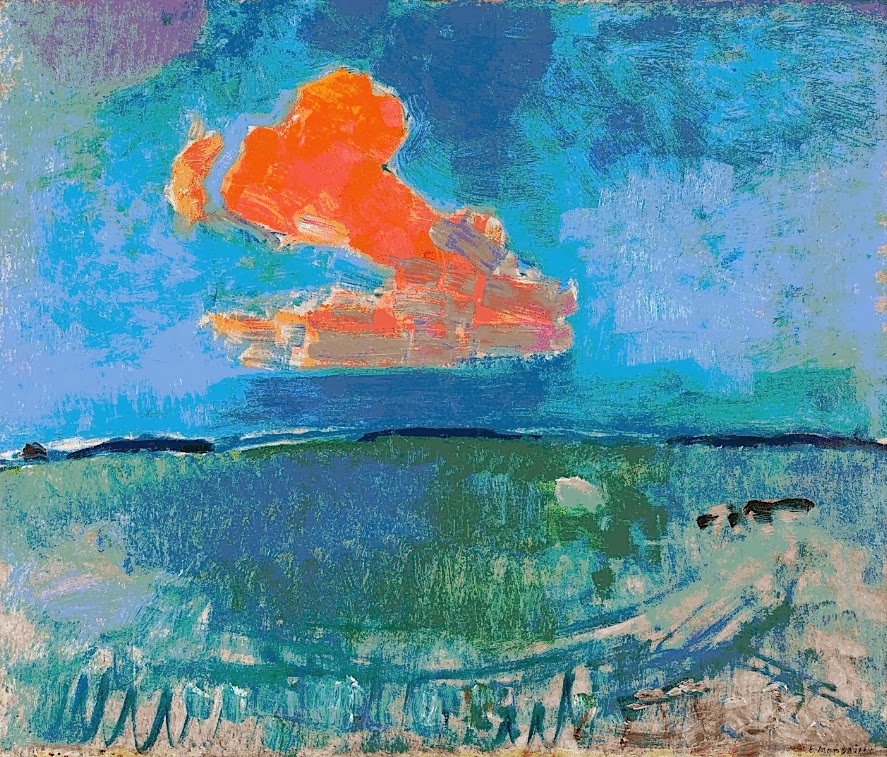
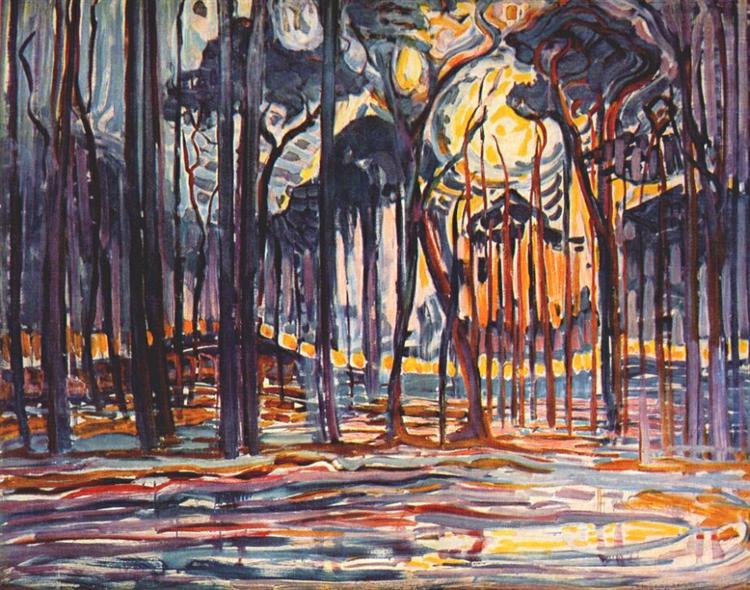
The second experience was the Quadrennial Exhibition held in Amsterdam in 1907 and featuring the Post-Impressionist works of Kees van Dongen, Otto van Rees, and Jan Sluijters. "The forceful expression and use of color inherent in Post-Impressionism are apparent in such works of the period as Red Cloud and Woods near Oele ..."

Red Cloud, 1907
Piet Mondrian

Woods near Oele, 1908
Piet Mondrian

Mondrian adopted several traits of Post-Impressionism and Pointilism as shown in two of his works from the period: Windmill in Sunlight and The Red Tree. For example, he reduced his palette to the basic hues, with Windmill in Sunlight created mainly in yellow, red, and blue.

Mill in Sunlight: The Winkel Mill, 1908
Piet Mondrian

The Red Tree, 1908 - 1910
Piet Mondrian

In 1909 Piet organized an exhibition with Cornelis Spoor and Jan Sleijters at Stedelijk Museum where this type of work was shown. The exhibition featured 250 of Mondrian's works and juxtaposed his early efforts with the later, more modern ones. This show "firmly established the artist as part of the Dutch avant-garde" (prabook.com).

In 1910, his modern works received good reviews at the St Lucas Exhibition in Amsterdam and in 1911 one of his more abstract works was accepted by the Salon des Indépendants.

In 1910 Mondrian co-founded a progressive artists club called Moderne Kunstkring with Jan Sluijters and Conrad Kickert. One of the intentions of the club was the curation of an exhibition of Dutch and foreign artists in Amsterdam. In preparation for the first such exhibition, Mondrian traveled to Paris in 1911 to see the latest artistic trends. 

The group's first exhibition was held at the Stedelijk Museum in 1911 and was the first ever museum presentation of Cubism. It featured artists such as Georges Braque, Raoul Dufy, Le Fauconnais, Pablo Picasso, and Maurice de Vlaminck. Mondrian was deeply impressed with the Cubist works and decided to move to Paris, the home of Cubism.

@EverythingElse23e

Thursday, August 4, 2022

Piet Mondrian: The early years of a seminal modern art figure

Today Piet Mondrian "is considered a seminal figure within the development of abstraction, and his oeuvre exerted significant influence on subsequent artists and movements, including the Bauhaus and later Minimilism. His works are included in numerous museum collections worldwide ..." (Sothebys.com). Before arriving at the point of his renown, however, Mondrian "went through many stylistic phases, as his paintings evolved from landscapes and still lifes that looked backwards at time-honored Dutch traditions, to the scintillating geometric canvasses for which he remains best known today." I will explore Mondrian's life and works in a five-part series inclusive of this post.

Tableau I, 1921
Piet Mondrian

Before I begin my exploration of Mondrian's life and works, let us take a look at the Dutch art world that existed at his birth. First, there was a hierarchy in terms of painterly works, with history paintings (included mythology, allegory, and religion; was generally done on a larger scale; and also included recent history) at the top of the pecking order followed by portraiture, genre painting (figures engaged in ordinary activities), still life, and landscape, in that order. There were some aspects of this art hierarchy that were pronounced/unique to Holland: (i) In the still-life arena, animal paintings were popular and (ii) landscapes tended more towards seascapes.

The requirements of the Calvinist theology led to the formation of a new painting regime focused on church interiors. Calvinism held that imagery was idolatrous and, as such, no paintings were allowed in churches. Instead, the focus in the interior of the church was on geometric harmony and balance and artists of the day sought to capture those structures and effects on canvas.

Mondrian was born on March 7th, 1872, in Amersfoort -- a city and municipality in the province of Utrecht -- the second of five children born to Pieter Cornelius Mondriaan and Johnanna Christina Mondriaan. His father was a devout Calvinist who spent his entire career teaching drawing in Calvinist schools. When Piet was 8 years old, his father was promoted to Headmaster of a Calvinist primary school, prompting a family move to Winterswijk. Piet lived in that town until he was 20 years old.

Both his father and uncle gave him guidance and instruction when he began studying drawing at age 14. His uncle -- Fritz Mondriaan -- belonged to the Hague School of landscape painting and had been taught by William Marz, a famed member of that selfsame school.

Piet was bent on becoming a painter but sought to mitigate the concerns of his family by gaining a degree in education first and by 1892 he was qualified to teach drawing in secondary schools. In furtherance of his painting goals he began taking lessons in 1892 in a small town close to his residence. He subsequently moved to Amsterdam to register at the Rijksacademie where he excelled. While in Amsterdam, Piet earned his keep by selling copies of old masterpieces.

He became a member of the Kunstliefde art society in Utrecht and had his first paintings exhibited in 1893. He joined two local artist societies in Amsterdam in 1894 and had a second exhibition of his works in 1897.

Piet Mondriaan

Up to the turn of the century, Piet's paintings followed the trajectory of contemporary Netherlands art. He painted landscapes and still lifes of the areas surrounding Amsterdam.

Wood with Beech Trees, 1899
Piet Mondrian

Mill of Heeswijk Sun, 1904
Piet Mondrian

In 1903 he visited a friend in Brabant and stayed over until the following year. The "calm beauty and cleanliness of the landscape" impacted him, as evidenced by the nature of his work post his return to Amsterdam in 1905. The landscapes he began painting had a "pronounced rythmic framework and a compositional structure rather than toward the traditional picturesque values of light and shade."

Willow Grove: Impression of Light and Shadow, c. 1905
Piet Mondrian

Piet had his first one-man exhibition in 1909, the same year that he became a member of the Theosophic Society. The Society was a spiritual organization centered around the teachings of Buddhism with "prevalent influence in Europe at the start of the 20th century." His involvement "led to a level of spirituality in his paintings which he believed helped his ... audiences reach a holy type of realm when viewing his works." "His involvement within Theosophy went on to influence Mondrian's goal of portraying absolute harmony in his works."

@EverythingElse238

Sunday, July 31, 2022

Art + History: The Third of May 1808 (1814) by Francisco Goya

Paul Glenshaw is one of the premier storytellers at the Smithsonian Institution; his Art + History series serving as proof of that assertion. I have previously reported on his skills in recounting his description of The Gross Clinic and I evidenced them again in his recent presentation on The Third of May 1808, Francisco Goya's iconic 1814 painting. 

The Third of May, 1814
Francisco Goya

The subject work was created in Madrid in 1814, went into storage in the Prado in 1834, and had its first known public display therein in 1872. The painting depicts the execution of individuals who participated in a May 2nd (1808) uprising against Napoleon. In this post I provide Glenshaw's context (supplemented with some secondary research) for the painting and its components.

Francisco Goya
Francisco Goya was born on March 30, 1746 in Fuendetodas (his mother's village) to a lower middle class family. His father being a gilder, he was born into a world of creativity. He spent the majority of his childhood in Zaragossa where he began his artistic studies -- at the age of 14 -- under the painter José Lugán. Those studies were completed after 4 years after which Francisco went to Madrid to study under Anton Raphael Mengs, a German who was Court Painter to the Spanish Royal Family.

According to franciscogoya.com, Goya clashed with his Master and his examination was unsatisfactory. He submitted entries for the Royal Academy of Fine Arts in 1763 and 1766 but failed on both occasions.

Portrait of Goya, Vicente Lopéz Portana, c.1826

Francisco studied in Rome and travelled all over Europe. One of his early works from this period was Sacrifice to Pan (1771)

Sacrifice to Pan, 1771
Francisco Goya

His painting The Victorious Hannibal came in second in a painting competition organized by the City of Parma.

Hannibal the Conqueror, Viewing Italy for the first time from the Alps, 1770 - 1771
Francisco Goya

He returned to Zaragoza in 1771 and painted parts of the cupola of the Basilica of the Pillar (including Adoration of the Name of God).

Adoration of the Name of God, 1772
Francisco Goya 

In Zaragoza Goya studied with Francisco Bayeu and eventually married the latter's sister Josefa with whom he had eight children. This relationship (Bayeu was a member of the Royal Academy of Fine Art) helped Goya to secure work as a painter of designs to be woven by the Royal Tapestry Factory. His work on the patterns brought him to the attention of the Royal Court (franciscogoya.com):
  • Appointment as a member of the Royal Academy of Fine Art
  • In 1783, the Count of Floridabianca commissioned Goya to paint his portrait
  • He spent two summers painting portraits of the Crown Prince Don Luis and his family
  • He painted portraits of the Duke and Duchess of Osuna, the King, and other notables during the 1780s
  • In 1786 he was given a salaried position as painter to Charles III
  • In 1789 he was made Court Painter to Charles IV
  • In 1799 he was appointed First Court Painter
  • In addition to the Royal Family, Goya received commissions from many members of the Spanish nobility.
In 1792 Goya left Madrid for Cadiz where he was struck down by a mysterious illness which manifested as dizziness, hallucinations, and, eventually, a loss of hearing.

The Political Environment
The French Revolution was launched around this time with Napoleon eventually taking the reins of the country. As it relates to geopolitics, England was allied with Portugal while Spain was weak. This state of affairs concerned Napoleon as he feared that Spain would fall to England and France.

In 1808, Fernando, son of King Charles IV, staged a coup and forced his father to abdicate. Napoleon had Charles and Fernando meet with him to discuss the political crisis and forced them to abdicate in favor of Napoleon's brother Joseph. Both Fernando and Charles were sent into exile. Napoleon then sent in French troops to solidify the takeover.

On May 2nd, the local population exploded in fury at the state of affairs and proceeded to attack the French troops. The Spanish troops handed out weapons to the upstarts so that they could battle the French on a more equal footing. 

On the 3rd of May additional French troops were deployed to bring the uprising under control. Recalcitrants were rounded up and shot.

Goya's Rendition of Events
Years later Goya was given a commission to commemorate the event. He began with the events of the 2nd of May, showing the uprising in the center of the city with Spanish citizens battling the Mamelukes and French officers. The scene is chaotic, with dead bodies on the ground juxtaposed against the action of battle and the solidity of the background architecture.

The Second of May 1808, 1814
Francisco Goya

The painting Third of May shows the events of the following day. 

Third of May 1808, 1814
Francisco Goya

There is a hill and a building in the background and people are coming into the foreground from that space. The foreground is dominated by a firing squad on the right side of the painting, a lantern in the center, and targets/victims on the left.

The detail below focuses on the members of the firing squad. In this detail we see humans as killing machines: no faces; similar clothing; and almost merged guns. The knapsacks are different so they are individuals. No feelings are exhibited here. The ground around their feet are illuminated by the lantern  but only two partial shadows are cast.

Detail of Francisco Goya's Third of May 1808

In the detail below we see the square lantern lighting up the victims, showing what has already been done; and what is to come. The ground in front of the victims is splattered with the blood of the dead and wounded while those still standing are in various stages of acceptance of their fates. The central figure is clothed in white and gold and stands, eyes bulging and hands upraised. The light from the lantern emphasizes this individual.

Detail of Francisco Goya's Third of May 1808

Goya never exhibited any political inclinations during his life but apparently thought that those May events should be memorialized. According to artincontext.org, it was Goya who presented the idea of the paintings to the Spanish government and they commissioned the works.

According to artincontext.org, this painting "... is widely acclaimed by many art sources as being one of the 'first' modern art paintings" in that "the subject matter and artistic technique depart from what was expected at the time from history paintings ..." and influenced a number of artists ( Edouard Manet, The Execution of Emperor Maximilian (1868 to 1869); Pablo Picasso, Guernica (1987); Pablo Picasso, Massacre in Korea (1951); and Robert Ballagh, The Third of May after Goya (1970)) to produce "paintings related to execution from war."


©EverythingElse238

Tuesday, July 5, 2022

Stonehenge: An example of prehistoric art today, a solar calendar then?

 I have previously provided an overview and timeline of prehistoric art and provided deep dives into two examples: The Venus of Willendorf (Willendorf, Austria, 28,000 - 25,000 BCE) and The Lion Man of Hollenstein-Stadel (Hollenstein-Stadel, Germany; 30,000 - 28,000 BCE). Both of these items originate in the Paleolithic era and are relatively small in size.

In the Neolithic period, humans had acquired the skill to work with large pieces of stone and created works which are referred to as megaliths (or megalithic art). “Megalithic art embraces any artistic entity involving the use of large stones, notably carving, relief sculptures and … megalithic architecture.” Stonehenge, located on the Salisbury Plain in Wiltshire, England, falls into this class and is the subject of the current post.

Stonehenge: Location and Construct
According to Wikipedia,
Stonehenge is a prehistoric monument on Salisbury Plain in Wiltshire, England, two miles (3km) west of Amesbury. It consists of an outer ring of vertical Sarsen standing stones, each around 13 feet (4.0 m) high, seven feet (2.1 m) wide, and weighing around 25 tons, topped by connecting horizontal lintel stones. Inside is a ring of smaller bluestones. Inside these are free-standing trilothons, two bulkier vertical Sarsens joined by one lintel. The whole monument  … is aligned towards the sunrise on the summer solstice. The stones are set within earthworks in the middle of the densest complex of Neolithic and Bronze Age monuments in England, including several hundred tumuli (burial mounds).
Stonehenge (londonforfree.net)

Geographic positioning of Stonehenge

Source: brian.mountainman.blogspot.com

Timelines for the construction can be found in writings from Stonehenge Tour Guide, English Heritage, and Britannica.

Bluestones
These are the oldest of the stone structures at Stonehenge. According to stonehenge.co.uk, a total of 82 stones from the Preseli Hills eventually made their way into the monument that is Stonehenge. The stones are a mix of igneous and volcanic rocks; weigh, on average, between 1 and 2 tons; and were originally sourced from two ancient quarries located in the Preseli Hills of west Wales. 

These stones did not make their way directly from the Preseli Hills quarries to Stonehenge, however. Radiocarbon dating showed activity at the quarries 300 to 500 years "before the earliest installation of bluestones at Stonehenge."

Archaeological studies have shown that some of these stones were initially associated with Waun Mawn, an arc of four standing stones located on Waun Mawn Hill, a site located three miles from the Preseli quarry. Waun Mawn is approximately 5000 years old and is located 124 miles northeast of Stonehenge. Excavations have shown that the site was originally home to a complete circle of stones. The stones missing from the circle were removed and transported to the Salisbury Plain sometime around 3000 BCE.

According to Brittanica, a bluestone circle measuring 30 feet in diameter was built along the banks of the Avon River, approximately 1 mile distant from Stonehenge. This site, known as Bluestonehenge, was discovered in 2009 by the Stonehenge Riverside Project and it is postulated that its 25 stones were incorporated into Stonehenge during one of its building stages.

Th total of 82 bluestones posited by Stonehenge.co.uk exceeds the number of stones scavenged from Waum Maun and Bluestonehenge combined, so it is likely that some of the Bluestones emplaced at Stonehenge, while also originating from the Preseli Hills, utilized another route to get there.

According to Stonhenge.co.uk, the bluestones were installed as an incomplete double circle during the second phase of Stonehenge construction and then rearranged into the circle (60 stones) and horseshoe that we see today sometime around 1500 BC.

Sarsen Stones
These represent the bulk of the building material at Stonehenge. This silicified sandstone is generally found as scattered blocks on the chalk of southern England. Standing at 7 meters tall, and weighing 20 tons on average, this stone type represents all the stones found in Stonehenge's central horseshoe, the uprights and lintels of the outer circle, and outlying stones.

The main circle consists of 30 large stones, many of which are tipped over. There are 10 additional stones within the circle and four stones outside.

The 52 stones visible today are thought to be the remnants of 85 stones originally installed in 2620 - 2480 BCE. Fifty of these stones have been traced to West Woods, a site 25 km north of Stonehenge. Stones 26 and 60 do not match up (composition-wise) to the other stones, to each other, or to any proximate quarry site.

Stonehenge Landscape Prior to Monument Construction
According to a study conducted by the University of Southampton: "Four thousand years before Stonehenge was constructed, land within the World Heritage Site was covered by open woodland, with meadow-like clearings, inhabited by grazing animals and hunter-gatherers ..." Animals resident on the landscape during this period included aurochs, red deer, elk, and wild boar, a bounteous offering for the co-resident humans.

Research from the University of Birmingham and Ghent University indicate that the area was a hunting hotspot for a lengthy period. The research has "uncovered hundreds of what appear to be large prehistoric pits dug to trap large prehistoric game ..." The earliest of the excavated pits dates from 8200 - 7800 BCE, with a 7000 year span between that and the youngest, indicating utilization of this hunting method from the early Holocene to "later Bronze Age inhabitants of farm and field."

Who Built Stonehenge?
Stonehenge was not built by the hunter-gatherers who had roamed the island for millenia before its construction. Rather, DNA analysis shows that this native population had been supplanted by migrant farmers descended from a group which had originated in Anatolia (Turkey), settled temporarily in modern-day Iberia, and then made its way to Britain. Let us take a more detailed look at the origin of these farmers.

Sedentary farming communities are thought to have emerged independently -- in the 10th millenium and early 9th millenium (BCE) -- in parts of the Fertile Crescent and in Central Anatolia. "The spread of farming and Neolithic migration is evidenced by the abandonment of Neolithic settlements across the region in the 7th millenium. This abandonment drove migration to NW Anatolia, western Anatolia, and SW Europe." By the period covering 7000 - 5000 BC, the migration had reached SE Europe.

Prior to the expansion of these agriculturists, Europe had been populated by hunter-gatherers but they were overwhelmed by migration waves using either the Danube or Mediterranean routes. The migrants who used the Danube route brought agriculture to central and western Europe. Some of the migrants using the Mediterranean route made their way to Iberia where they settled temporarily before continuing on to Britain. By 4000 BC they had made landfall in Cornwall and Wales. 

"The majority of the population in Britain at the time of the construction of Stonehenge ... were descended from those who settled in Iberia." These migrants brought farming techniques, pottery, and new religious cultures and beliefs.

Stonehenge: Reason for Being
A number of reasons have been advanced over the years as to the purpose of Stonehenge: burial site, celestial observatory, religious site, proof of alien visitation to Earth, etc. None of the foregoing have been widely accepted. We do know that between 150 and 240 men, women, and children were interred at the site during the first phase of its construction -- and between the first and second phases -- but, given the paucity of burials in subsequent phases, that could not have been its sole purpose.

Professor Timothy Darvil of Bournemouth University in England has recently advanced the theory that the monument functioned as a solar calendar. The calendar is, according to Dr. Darvil, built around the Sarsen stones which, in addition to having been installed at the same time (around 2500 BC), have retained formational integrity throughout time (unlike the bluestones, which were rearranged around 1500 BC). According to Darvil, the monument "served as a physical representation of the year ... and helped the ancient inhabitants of Wilshire keep track of the days, weeks and months."

The schema for the proposed calendar is as follows:
  • Each of the 30 stones in the Sarsen circle represented a day in a month
  • The months were divided into 3 weeks of 10 days each
    • Distinctive stones in the circle marked the beginning of each week
  • An intercalary month of 5 days and a leap day every 4 years mapped the system to the solar year
    • The intercalary month was represented by the five Trilothons at the center of the site
    • The four station stones outside the circle provide markers to count off to the leap day
  • The winter and summer solstices were framed by the same two stones every year
According to the professor, such a solar calendar was developed in the eastern Mediterranean in the centuries after 3000 BC, was adopted in Egypt as the Civil Calendar around 2700 BC, and was widely used at the start of the Old Kingdom around 2600 BC.

*******************************************************************************************************
The early stages of Stonehenge was built by Neolithic farmers who, in supplanting the hunter-gatherers, brought farming techniques, pottery, and new religious and cultural beliefs to the island. With the transition from the Stone Age to the Bronze Age, the monument is surrounded by the burial mounds of the elite: "farmers, traders and warriors who were deeply intertwined with Continental Europe."

And it is to that Bronze Age we next turn in this survey of art history.

©Everythingelse238

Wednesday, March 16, 2022

Prehistoric Art: The Lion Man of Hohlenstein-Stadel

Investigators regularly conduct scientific research on Prehistoric Art items in a quest to understand the composition of the artifacts, their origins, their ages, construction techniques, and utility. In this series I am reporting on a subset of these artifacts, continuing herein with the Lion Man of Hohlenstein-Stadel.

The Lion Man of Hohlenstein-Stadel

The British Museum blog describes the Lion Man figurine thusly:

The Lion Man is a masterpiece. Sculpted with great originality, virtuosity and technical skill from mammoth ivory, this 40,000-year-old image is 31 centimeters tall. It has the head of a cave lion with a partly human body. He stands upright, perhaps on tiptoes, legs apart and arms to the sides of a slender, cat-like body with strong shoulders like the hips and thighs of a lion. His gaze, like his stance, is powerful and directed at the viewer. The details of his face show he is attentive, he is watching and he is listening. He is powerful, mysterious and from a world beyond ordinary nature. He is the oldest know representation of a being that does not exist in physical form but symbolizes ideas about the supernatural.

Recovery and Reconstruction
The fragments of the Lion Man figurine were extracted from the Hohlenstein-Stadel Cave in a series of excavations which begun in 1939 and ran on and off through 2013.

Hohlenstein is a large, rocky massif located in Germany's Swabian Jura whose limestone structure has been hollowed out in some areas to form caves, three of which - Stadel, der kleine Scheuer, and Bärenhöhle -- are of archaeological and paleontological significance. The location of the Stadel Cave is indicated on the map below.

The red dot indicates the location of the Hohlenstein-Stadel Cave

As shown in the timeline below, the first Lion Man fragments were found in the 1939 field season excavations of Robert Wetzel but it was not until the Hahn inventory in 1969 that the significance of the earlier finds was recognized; and not until 2013 that the fullest accounting of the figure was manifested.


Who built the Lion Man
Radiometric tests of Lion-Man-adjacent debris dates the figure to the late Aurignacian, "... a tool culture named after the type site of the Haute-Garonne area in France and noted for its 'mode 4' flint tools characterized by blades from prepared cores, rather than flint blades of earlier man. It was one of the more productive Paleolithic areas in terms of petroglyphs and pictographs produced" (British Museum).

Production of the Lion Man was a very expensive affair for its ownership group. Experiments conducted using the same types of tools employed in his production revealed that 400 hours were required to complete the figure, a significant allocation of time to activity not directly related to physical survival in the harsh environment of the time. This brings two thoughts to the fore:
  1. To prehistoric man, there were things that were just as important as physical survival
  2. The craftsmanship and belief system associated with the Lion Man did not spring up out of whole cloth at the time of the creation of the figurine.
Use of the Lion Man Figurine
According to the British Museum blog, the Lion Man fragments were found in a small chamber at the back of the cave, somewhat removed from the habitable area at the cave's entrance.The figurine was carefully put away in the dark in the company of a few perforated arctic fox teeth with a cache of reindeer antlers and unmodified cave bear bones proximate.

As regards the cave, it did no set up well for human habitation:
  • The cave faces north and does not get much sun. This lack of warmth would limit its attractiveness as a habitable abode.
  • The density of human-habitation debris was markedly less than was the case at other nearby sites/
These facts suggest that the cave was a place where people gathered only occasionally. As described by the British Museum, "... Stadel Cave was only used occasionally as a place where people would come together around a fire to share a particular understanding of the world articulated through beliefs, symbolized in sculpture and acted out in rituals." 

Lion Man, then, is the "oldest proof of a numinous belief system among the first anatomically modern humans in Europe."

Saturday, March 12, 2022

Research into the origin of the Venus of Willendorf

Investigators regularly conduct scientific research on Prehistoric Art items in a quest to understand the composition of the artifacts, their origins, their ages, construction techniques, and utility. In this series I will report on recently published research on a subset of these artifacts beginning herein with the Venus of Willendorf.


The Venus figurine was discovered in 1908 during the course of archaeological excavations on the left bank of the Danube in Willendorf, Lower Austria. The map below shows the location of the village in which the Venus was first located as well as the city (Vienna) in which it is now housed.

Red blob indicates the village of Willendorf, the
location where the Venus was discovered

The figurine was carved from oolitic limestone ("made up of small spheres called ooiliths that are stuck together by lime mud. They form when calcium carbonate is deposited on the surface of sand grains rolled (by waves) around a shallow sea floor" -- assignmentpoint.com), a formation not local to the Willendorf area. This fact dictates a non-local origin for the Venus. A search for those origins was the basis of the study led by Gerhard Weber and titled "The microstructure and the origin of the Venus of Willendorf."

The first order of study business was determining the structural composition of the Venus. "Because of the unique value of the Venus from Willendorf, one of the most famous signs of early modern human symbolic behaviour, invasive investigations have been impossible since its discovery in 1908. The availability of micro-computed tomography provided the first chance to radiograph the figure in 3D in a resolution close to thin-sections and microscopy, which paved the way to explore the interior of the raw material" Weber, et al. Analysis of the scan data allowed researchers to establish a profile of the material comprising the Venus and to date the oolites as originating in the Mesozoic age (251 - 66 mya)

The second step in the process was to compare this baseline against oolitic limestone samples drawn from France, Ukraine, Crimea, Germany, Sicily, and Sega di Ala, a location in a side valley of Lake Garda. According to the authors, the samples from Sega di Ala were "indistinguishable from samples drawn from the Venus material." The researchers continue: "Even if we cannot  claim with absolute certainty that the raw material of the Venus originates from a particular locality, the match between the Venus and the Sega di Ala samples is almost perfect and suggests a high probability for the raw material to come from south of the Alps."

The authors simulated travel along two prospective paths from Lake Garda to Willendorf: a 730-km path through the Alps and a 930-km path which bypassed the Alps. 

Simulated potential paths for Venus: Red for the northern path through the Alps, black for the southern, non-Alps route

The authors surmise that the shorter path would only have been undertaken under some type of duress and consider the longer path the most likely route along which the Venus (or its material) was carried. Further, such a journey could have taken years, or even generations, but, in the authors' view, the material was handled carefully along the way.

Key findings here are as follows:
  • The Venus is not local to Willendorf
  • The material from which it was crafted was sourced from an area south of the Alps and relatively proximate to Sega di Ala
  • It is not known whether the Venus was manufactured at its point of origin, somewhere along its travel route, or at its final destination. What is known is that great care was taken of the material/artifact during its transit
  • It is quite likely that the transit period was lengthy.
©EverythingElse238

In the Footsteps of Piero della Francesca: Meetup and the Maddalena

Piero della Francesca's import to pre-Renaissance art and how I became involved in a trip to walk in his footsteps have previously bee...