Thursday, January 16, 2020

2020 "must-visit" art museum exhibitions

As I did last year, today I am publishing a list of the "must-see" Museum exhibitions on tap for 2020.


I created the file in Google Sheets which assures dynamic updating of this page on the basis of any changes made to the source document. The exhibition names provide links to fuller descriptions of the events.

Happy trails.


©EverythingElse238

Tuesday, December 10, 2019

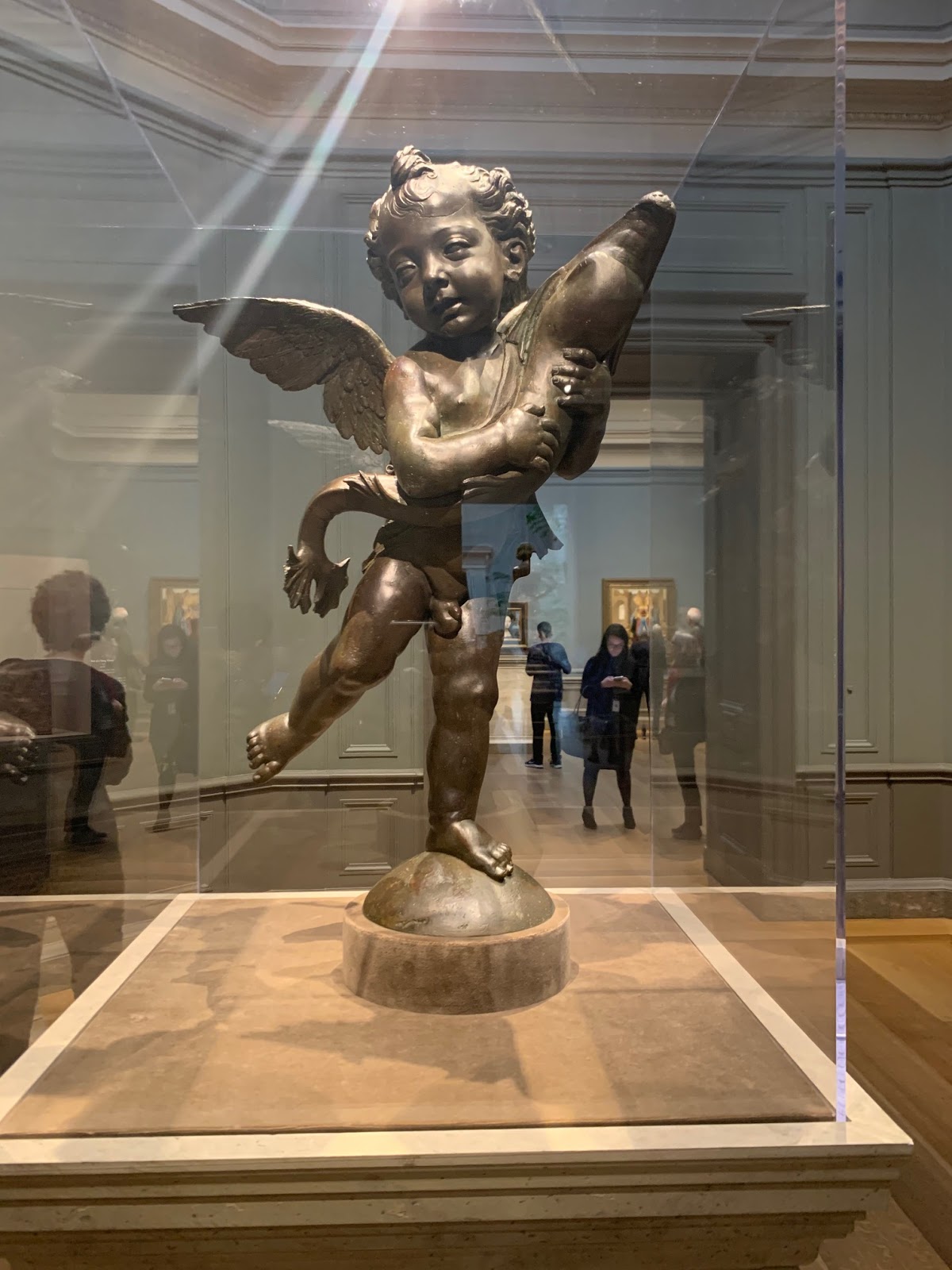
Verrocchio: Sculptor and Painter of Renaissance Florence

According to Isaacson (Leonardo da Vinci) Cosimo de' Medici took over his family's banking business in the mid-1430s and grew it into one of the largest and richest banks in Europe. Further, "by means of payoffs and plotting, Cosimo became the de facto ruler of Florence and his patronage made it the cradle of Renaissance art and humanism." His grandson Lorenzo -- dubbed the Magnificent -- would extend this patronage by sponsoring artists (Botticello and Michelangelo, for example) and workshops (Andrea del Verrocchio, Domenico Ghirlandaio) who were producing paintings and sculptures for the beautification of the city.

According to the National Gallery of Art, Verrocchio was one of the leading artists of late 15th-century Florence, as a sculptor, "the most important figure in the Renaissance between Donatello and Michelangelo." His works were "of unprecedented technical accomplishment and breathtaking naturalness and beauty."


Verrochio is the focus of an exhibition -- Verrocchio: Sculptor and Painter of Renaissance Florence -- currently on show at the National Gallery of Art (NGA). The exhibition showcases 50 pieces by Verrochio and associated artists and is arranged thematically to show Verrocchio as a sculptor, painter, teacher, and draftsman.

Leonardo da Vinci was apprenticed to Verrocchio and, in his biography of the former, Isaacson provides some insight into the latter's workshop and teaching practices. The shop was on two levels with the ground floor dedicated to production and assistants eating and sleeping together of the top floor. The training regime was intensive with studies around surface anatomy, mechanics, drawing techniques, and the effect of light and shade on material such as draperies

Objects were mass-produced by the students in pursuit of a goal of a constant flow of marketable art and artifacts. Verrocchio himself was trained as a goldsmith so left much of the painterly activities to others. He was a kind master; so much so that many of his students (Leonardo included) continued to live and work with him after their apprenticeships were completed. Notable students included Lorenzo di Credi, Pietro Perugini, Leonardo, Botticelli, and Ghirlandaio.

The exhibition featured shared works between Verrocchio and one or more of his students plus works attributable to some of his more famous students. In the painting arena, NGA views Verrocchio as forming "a direct link in the central chain of Florentine painting between his master Fra Filippo Lippi and his own pupil Leonardo da Vinci."

Andrea del Verrocchio, Leonardo da Vinci, and
Assistants
Tobias and the Angel, c. 1470
tempera on panel

It is generally held that Leonardo painted the dog and fish in the above painting.

Sandro Botticelli
Madonna and Child, c. 1470
Tempera on panel

Andrea del Verrocchio and Domenico Ghirlandaio
The Virgin Adoring the Christ Child, c. 1475/1480
Tempera and oil on panel transferred to canvas

Leonardo da Vinci
Portrait of Ginevra de' Benci, c. 1474/1478
Oil and tempera on panel

Andrea del Verrocchio and assistants
Madonna and Child with Two Angels, c. 1470/1474
Tempera on panel

Domenico Ghirlandaio
Madonna and Child, c. 1475

Verrocchio's greatest sculptural work is generally considered to be the Equestrian statue of Bartolomeo Colleoni in Venice, a piece that he did not live to see cast in bronze. In speaking of Verrocchio's skill as a sculptor, Isaacson saw his "ability to convey the subtleties of motion in a piece of still art" as one of his most under-appreciated talents. "More than most previous artists, Verrocchio imbued his statues with twists, turns, and flows."

Andrea del Verrocchio
David with the Head of Goliath, c. 1465
Bronze with partial gilding

Isaacson refers to David as one of Verrocchio's most captivating sculptures. "It quavers between expressing a childlike glory and a dawning realization of future leadrship; a cocky smile is caught in the moment of being transformed into resolution. Unlike Michelangelo's iconic marble statue of a muscular David as a man, Verrocchio's David seems to be a slightly effiminate and strikingly pretty boy of about fourteen." It has been speculated that Leonardo served as the model for David.

e
Andrea del Verrocchio and assistant
Alexander the Great, c. 1480/1485
Marble

Giuliano de'Medici, c. 1475/1478
Terracotta with traces of polychromy

Lorenzo de' Medici, c. 1513/1520
Polychrome terracotta


Andrea del Verrocchio
Putto with a Dolphin,  c. 1465/1480
Bronze
(The first Renaissance sculpture created to be
equally beautiful from all angles)

Small but powerful exhibition which showcases the work of Verrocchio but, moreso, his influence on Renaissance art due to the students that he mentored; students who went on to attain greater acclaim than he did.

©EverythingElse238

Friday, October 11, 2019

Bassquiat and Purvis Young at Tampa Museum of Art: Ordinary/Extraordinary Assemblage in Three Acts

Contrary to the museum's protestations to the contrary, the juxtaposition between the lives and art of the black American artists Jean-Michel Basquiat and Purvis Young is thrown into sharp relief in exhibits of their work at Tampa Museum of Art. The two discrete shows (Jean Michel Masquiat: One Master Artist/Two Masterpieces and Purvis Young: 91) are part of an exhibition series titled Ordinary/Extraordinary Assemblage in Three Acts; the third show in the series is titled Sacred Diagrams: Haitian Vodou Flags from the Gessen Collection.

Each of the foregoing can be viewed as a separate show but, according to the museum, are linked by
... the use of found objects, such as discarded wood and repurposed textiles ... More importantly, historical and socio-economic narratives informed by the Afro-Caribbean Diaspora, the black experience in America, as well as European artistic influences unite the artists featured in the series.
I will focus on the Basquiat and Young shows in this post.


This is the second exhibition of both artists works that I have attended this year -- Basquiat at the Brant and Young at the Deland Museum of Art -- and I am struck by more of the contrasts than the commonalities between the two artists. The chart below is illustrative.

The way that the individual shows are exhibited also provides a juxtaposition, with two Basquiat originals emplaced on a wall, with significant white space around each piece, and, in the next room, separated by a perpendicular wall, the cacaphony of the Young exhibition.


The first of the two Basquiat paintings (Untitled (Word on Wood)) is one of 17 Basquiat paintings that incorporates wood fence slats. The slats are painted black and divided into two unequal hemispheres. The upper hemisphere is dominated by a blue square with a gold border which serves as a frame for an African-mask-like structure with mismatched oval eyes and bared teeth. A line runs from a distinctly negroid nose through a unibrow to the top of the forehead, dividing the forehead into two unequally adorned hemispheres. The top of the head is festooned with light-brown, cornrow-type structures.

The lower hemisphere is populated by some of the markings for which Basquiat is known. The left, chair-like structure is brown in color and associated with a white comb marking while the right leg is entwined by a green vine and is adjacent to an upturned comb.

Untitled (Word on Wood), 1985
Jean-Michel Basquiat

The second painting is a collage of different textured items emplaced on a bright-yellow, two-hemisphere, wooden door. The Spanish word for miracle is repeated a number of times on the structure's upper hemisphere.

Yellow Door (1960), 1985
Jean-Michel Basquiat

As you walk around the dividing wall, you are suddenly confronted with the cacaphony of the Young series. The 91 paintings, the totality of the museum's Purvis Young collection, are hung shoulder-to-shoulder from floor to ceiling in honor of the author's "magnum opus:"


For a short period of time in the 1970s, Young installed his paintings from the ground to the rooftops of abandoned storefronts in his neighborhood. The Wall of Respect in Chicago, a mural that featured heroic black men and women painted at the height of the Civil Rights Movement, influenced Young. He aimed to replicate the Wall of Respect in Overtown with his powerful, provocative paintings and often overlapped the paintings in an extreme salon-style hang. Titled Goodbread Alley Mural, the project was on view from approximately 1971-74 until the City of Miami started to dismantle the artwork. The installation on view in this gallery takes inspiration from the Goodbread Alley Mural ...
I found this layout jarring: I was not sure whether I should evaluate it as a mural or evaluate each piece on its own. In general I find Young's work slightly claustrophobic -- due to the object density on his pieces -- and that feeling was on steroids with so many of his pieces stacked together. Museums are requesting that patrons spend more time evaluating paintings on view: I do not believe that this layout advanced that objective.

It is not obvious how the Vodou Flags exhibit fits in with the works of these two well-known artists.

©EverythingElse238

Sunday, September 15, 2019

The immediacy of the Phillips Collection exhibition The Warmth of Other Suns: Stories of Global Displacement

In an opinion piece in the New York Times (Blessed are the Refugees, 9/13/19), Brett Stephens identified Harry Truman's signing of the 1948 Displaced Persons Act as the first time that US immigration policy "became actively sympathetic to the utterly dispossessed." As a result of this law, and subsequent legislative activity, the US accepted (Stephens):

  • 40,000 Hungarians who fled the Soviet tanks after 1956 (including the young Andy Grove who became the CEO of Intel Corporation
  • Hundreds of thousands of Cubans fleeing Castro's repression after 1959 (including a young Gloria Estefan)
  • 750,000 Soviet Jews fleeing persecution by Soviet despots (including a young Sergei Brin)
  • Over 1 million Vietnamese, Laotians, and Cambodians after the fall of Saigon
  • Hundreds of thousands of Iranians after the Khomeini revolution
  • In excess of 100,000 Iraquis since the fall of Saddam Hussein
  • Over 100,000 Burmese.

According to Stephens, a total of 3 million refugees have been accepted into the US since the Refugee Act of 1980 and "by almost any metric, America's refugees tend to succeed, or at least their children do. Whatever they do to enrich themselves, they enrich the country a great deal more."

In light of the foregoing, and the "ennoblement" that accrues to the US as a result of opening its doors to the displaced, the actions of the current administration renders this a "moment of unique shame for the United States" according to Stephens. The number of refugees has plunged from 97,000 in 2016 to 23,000 in 2018 with plans to potentially bring the number down to zero.

But the US is not the only major country to be moving in this direction. According to an article in today's New York Times (Patrick Kingsley, Is Trump's America Tougher on Asylum Than Other Western Countries?), "Mr. Trump's plan is also in keeping with a wider international trend  of curtailing the right to asylum, as western nations try to curb migration from the global south, where the overwhelming majority of displaced people live." Mr. Kingsley then goes on to detail actions that have been taken by the EU, Australia, and Israel to limit refugee flows.

It is within this context that The Phillips Collection has organized an exhibition titled The Warmth of Other Suns: Stories of Global Displacement. This exhibition, spread over three floors of the Goh Annex and Sant Building of the Phillips Collection premises at 1600 21st Street NW, Washington, DC.,
... brings together works of art from five continents to consider the current mass movement of people globally alongside historical migrations to and within the United States. Through sculpture, video, painting, photographs, and more, the exhibition poses urgent questions about representation and experience of migration and dislocation. The artists bear witness to both personal and historical events, many also questioning the capacity of images to portray reality and truth.

Material on the first floor of the exhibition focused primarily on providing context for the exhibition  plus two pieces focused o North America and the Mediterranean Sea.

There are two striking exhibits on platforms located alongside the stairway leading between the first and second floors. The items, which, at first sight, appear to be a jumble of blown glass and disparate ephemera, are representations of typical street hawkers of African cities. "These 'rescuers' are known for recycling salvaged goods to sell and are thought to 'save' their customers with their resale services. This particular savior is a passport seller, a welcomed figure of luck for desperate migrants."

Sauveteur (Passport Vendor 1), 2011
Pascale Marthine Tayou

The multimedia installations on the second floor focus on migrations and displaced persons in countries outside the US ranging from a group of Syrian refugees in the port of Lesbos, to a map of a refugee camp in Lebanon, to a Chinese artist's plaintive cry for his mother who had remained behind in China.

Queen Mary II, La mère (The Mother), 2007
Adel Abdessemed

Refugees 4, 2015
Liu Xiaodong

Mémorial aux Réfugiés Noyés (Memorial for
Drowned Refugees), 2016
Meschac Gaba


Ville de Calais, 2015 - 16
Henk Wildschut

Shabriha 1, 2001
Marwan Rechmaoui

Where is my Mother, 1926
Yun Gee

Maine Family, c. 1922 - 23
Yasuo Kuniyoshi

Liberty, N.Y., 2001
Zoe Leonard

The pieces on the third floor switch to a focus on migration in North America: from the wall on the Southern border and how it has split families apart; to the Trail of Tears, the forcible displacement of Native Americans from their southeastern homelands in the 1830s; to the migration of blacks from the South to the North beginning at the turn of the 20th century. The latter movement is captured in Jacob Lawrence's The Migration Series (1940 - 41), a 60-panel set, 30 of which are owned by The Phillips Collection and are displayed in this exhibition.

MOIA's NYC Women's Cabinet, 2016
Aliza Nisenbaum

The Wall (Component), 2015 - 2016
Griselda San Martin


Miguel & Christian, 2017
John Sonsini

Untitled, 1941
Diego Rivera

Traveling (Lead Kindly Light), 1918
William Edouard Scott

The Migration Series, 1940 - 41
Jacob Lawrence

Trail of Tears, 2005
Benny Andrews

This exhibition is thought-provoking and causes self-reflection on the part of the viewer. In today's environment, when being born in the Southern Hemisphere increases the likelihood of one being a refugee, thoughts run to what actions are available to us, the more fortunate. It caused me to look, contemplatively, at the potential for this situation to become even more dire in the future given the potential for climate-driven refugee flows.

This exhibition does not dwell on the whys of migration or offer any solutions going forward; but that is not its stated intent. Rather it seeks to inform and place the viewer within the minds and experiences of the refugee/displaced person. And it causes us to think about our shared humanity,

©EverythingElse238

Sunday, September 8, 2019

Franz Boas and his early battles against the "establishment" societal model -- after Charles King

In Chapter 3 of his book Gods of the Upper Air, Charles King provides the backstory of the evolution of the establishment position on societal organization and how Franz Boas came to oppose that position. I summarize the high points in this post.

A version of the word anthropology has been around since Aristotle but its impact and meaning has shifted over time. The first academic to have the name Anthropologist in his title -- Edgar Burnett Tyler of Oxford University -- defined the field as the "study of man" while early institutional use -- Britain's Royal Anthropological Institute and France's Musée d'histoire Naturelle -- placed the field as a branch of anatomy or natural history.

For early Anthropologists (a la Frazer), the secrets of human societies lay primarily in the texts that they produced. Beginning in the 1840s, a new word -- Ethnology -- made its way onto the scene, with the premise of extending the study of humans into their "ethnos." The US Government funded the Bureau of Ethnology, within the Smithsonian Institute, to go beyond what was ancient and written, to collect observable data about remote groups.

John Wesley Powell was appointed to head up the Bureau of Ethnology and he organized it -- and charged his staffers --after principles espoused by Lewis Henry Morgan. Morgan had studied the Iroquois Federation and had written a definitive tome on the history, language, and culture of this alliance. In a follow-up book -- Ancient Society -- he combined his Iroquois learnings with texts from ancient Greek and Roman sources in order to formulate a global model of how societies organize themselves. According to Morgan, all societies run through the same stages in their evolution, beginning with a simple form which becomes more complex over time.

Powell bought into this concept fully, making the book required reading for all staffers and then formalizing his construct in a March 1886 presentation to the Anthropological Society of Washington. The evolution of this thought process is shown in the chart directly below while the characteristics of each societal component are shown in the table immediately following.


Table 1. Identifying characteristics of the three societal components
Characteristic Savages Barbarians Civilized
Societal Organization Primary kinship group Tribe Nation-State
Language Individual words and simple concepts Complex phrases Languages capable of handling complicated abstract ideas
Music Beat out a rhythm on a log or a stone Sing a melodic line Added counterpoint and harmony
Religion Many gods, often represented as a beast or fowl Forces of nature as gods Single god

The role of the Ethnologist, according to the Bureau of Ethnology, was to study (King):
  • The frontiers between the stages of human progress and to describe how different peoples have travelled from one end of human culture to the other
  • The development of languages and other specific characteristics that defined each of them
  • The various institutions --- from tribes to states -- that allowed them to remain coherent units
  • Their changing opinions on life and the universe.
In this model, Ethnology was "simply the act of a civilized man conversing with those who had yet to travel the same pathway he had once trod."

After his initial work on Baffin Island, Boas had returned to Germany where he finally fulfilled the requirements for his Ph.D. Based on contacts he had made while in Germany, he returned to North America and traveled to British Columbia to collect cultural data on myths and folktales from North Coast inhabitants.

Upon the completion of that work, he returned to New York where he got a position as an Editorial Assistant at the young and struggling Science magazine. Shortly after beginning work, he traveled to Washington, DC to visit the Smithsonian's collection on the peoples of the Northern Coast. He was questioning of what he saw.


Boas felt that the museum's collection was mis-organized and would continue to be so because the data collection premise and framework were flawed. The solution, he felt, would emerge after comprehensive study of collected data rather than by going in with a template and trying to fit data into boxes. Boas used his platform at Science to argue his position but he was going up against much more powerful people and his contract at Science was not renewed upon its expiration.

©EverythingElse238

Sunday, August 25, 2019

Summary of Cultural Relativism drivers -- after Charles King

I have just begun reading Charles King's Gods of the Upper Air, the story of how Franz Boas, the German-born "father of American anthropology," and a small group of like-minded disciples, took on, and debunked, the commonly held beliefs on societal construct, race, sex, and gender.


In the first chapter, King does a masterful job of summarizing the views on society and individuals that held sway at the time and the "animating theory" that drove the "little group" to their competing views on race, sex, and gender. I illustrate the key aspects of the chapter in the charts following.

Compiled from Gods of the Upper Air


Compiled from Gods of the Upper Air


Pictures from wikipedia.com; illustration compiled from
Gods of the Upper Air

©EverythingElse238

Sunday, August 11, 2019

Summary of the major Low-Countries Northern Renaissance art movements

I recently embarked on multi-post effort to provide an overview of Dutch and Flemish art in the periods covered in a number of major current, and recently concluded, international art exhibitions. To date I have covered all of the major strains associated with the Northern Renaissance period and I summarize those in the chart shown below.


©EverythingElse238

In the Footsteps of Piero della Francesca: Meetup and the Maddalena

Piero della Francesca's import to pre-Renaissance art and how I became involved in a trip to walk in his footsteps have previously bee...