Friday, December 21, 2018

The Divine Michelangelo: His Life and his works

Washington DC was cold, grey, foggy, and wet last Saturday. Downwright dreary, and a great time to be indoors at the Smithsonian Institution exploring the works of of "The Divine Michelangelo" in a day-long seminar led by Art Historian Rocky Ruggerio (Rocky is an Art History professor and an Italian Renaissance expert. His bio can be found here.).

The opening slide in the professor's presentation was a portrait of Michelangelo done by Danielle de Volterra in 1550 and now in Teylers Museum in Haarlem.


According to Rocky, Michelangelo got a late start as an artist because his father was not too keen on that course; in that time it was a low-status calling. He was, instead, enrolled in a Humanist school at 10 years of age. At the age of 13 he was apprenticed to Domenico Ghirlandaio, a very important painter of the time. At the time of the apprenticeship, Ghirlandaio was engaged in painting the frescoes at the Tornabuoni Chapel, an effort that ran from 1485 to 1490.

Michelangelo was a precocious talent as evidenced by the fact that (i) his father was able to convince the Master to pay the apprentice (an unheard of situation) and (ii) when Lorenzo de Medici asked Ghirlandaio to send over two of his best students, Michelangelo was one of the two.

From 1490 to 1492 Michelangelo lived in the Medici Palace, interacting with, and learning from, the humanists living and teaching therein. While there he became friends with Giovanni Medici (who became Pope Leo X) and Guilo Medici (who became Pope Clement VII). According to Rocky, this friendship is demonstrated in the informal tones in the written communications between Michelangelo and these two powerful men.

The chart below is a pictorial summary of Michelangelo's work over his lifetime.


Michelangelo's first sculpture, Battle of the Centaurs, was completed in 1492. The subject is drawn from Ovid's Metamorphoses but the actual work is a glorification of the male nude form -- an overarching theme in the sculptor's works. Michelangelo was 17 years old when this effort was completed. It is currently housed in the Casa Buonarroti in Florence.

His second effort was Madonna of the Stairs, also completed in 1492. Both of his first two works were done in shallow relief (Rocky referred to it as relief flat), a technique wherein "... the plane is only very slightly lower than the sculpted elements." Rocky asked a rhetorical question as to why would Michelangelo be working in relief in his early years. In Rocky's view, Michelangelo, in his early years, was compared to Donatello who had invented this low, low relief process. In order to prove himself worthy of the comparisons, Michelangelo had to prove that he could acquit himself credibly using the Donatello techniques.

Bacchus was completed in 1496 when Michelangelo was 21 years of age. This was his first known professional contract. The sculpture is currently housed in the Bargetto Museum in Florence. The work was initially commissioned by Raffaele Riario  but he rejected it, probably due to the perception of inebriation projected by the piece, and it was subsequently picked up by his banker, Jacopo Galli.

Galli also purchased Michelangelo's next work, the Pietà, which was completed in 1498. This, according to Rocky, is one interpretation of the topic called Pietà; but it is the most famous representation. Rocky noted the incredible youth of Mary's face. When this piece was unveiled, people were blown away but no one knew who had done the work. During the night, Michelangelo climbed the statue and carved the following onto the surface: "Michelangelo Buonarroti of Florence made this." This is the only one of his works that he has signed. The piece currently resides in St. Peter's Basilica in Rome.

David is one of the most iconic sculptures of the modern age. Michelangelo carved this between 1501 and 1504, between his 26th and 29th years. The contract was let by the Building Center for Florence Cathedral in 1460, well before Michelangelo's birth. The sculpture was destined to be placed high-up on one of the Cathedral's buttresses. The first contract was canceled due to dissatisfaction with the sculptor. Antonio Rossolini was given the contract 10 years later but he was also fired.

When Michelangelo completed the effort, it was deemed too large to be placed on the buttress so the decision was made to place it in front of the Palazzo Vecchio. The statue was unveiled on September 8, 1504. The statue remained in the Piazza until 1873 when it was moved into the Galleria dell' Accademia. According to Rocky, this painting transcends the subject matter.

The Doni Tondo is the first painting that we have seen from Michelangelo. The patron of the piece was Angelo Doni and tondo means circular painting; hence the painting's name. The piece was completed in 1505 and currently resides in the Uffizi Gallery. The Classical, Greco-Roman, pagan world is represented in the background and the foreground represents the christian world. John the Baptist serves as a link between the two.

Pope Julius II wanted to restore Rome to its former glory. As a part of that vision, in 1505 he summoned Michelangelo to Rome to create a monumental tomb for him. The Pope subsequently re-directed Michelangelo from the tomb effort to painting the Sistine Chapel Ceiling. Michelangelo was paid 3000 Papal ducats for the effort. He hired a team to work with him but by the end of the process was doing most of the work himself. Early panels show greater number of individuals per panel but very quickly Michelangelo went to fewer, larger beings per panel. While there is a myth that he painted the ceilings while lying on his back, Michelangelo's correspondence, sketches, and griping show him painting while standing up. Michelangelo was not happy about doing this job, at one time supposing that his enemies had gotten him this assignment to punish him. This work was revealed on October 3, 1512.

Right after completion of the Sistine Chapel Ceiling, Michelangelo did the Moses and Dying Slave statues. 

Pope Leo X had Michelangelo do some design work for a facade for the Medici church in San Lorenzo. Work on this effort was suspended after Leo changed his mind and had Michelangelo work on the New Sacristy at San Lorenzo instead. This was Michelangelo's first architectural effort and he designed everything in the structure. The work was completed between 1519 and 1534 and included tombs of Lorenzo and Giuliano Medici and a sculpture of the Medici Madonna.

The Laurelton Library was designed in great detail by Michelangelo and he oversaw the work until he left Florence in 1539. The library was finally completed in 1571, based on the detailed plans that Michelangelo had left behind. The Staircase and the Reading Room of the library are exemplary pieces of functional art.

The Last Judgment, covering the entire altar wall of the Sistine Chapel, was worked on between 1536 and 1541.

Michelangelo completed two additional Pietàs before his death in 1564. The first, The Deposition, shows Jesus after he has been taken down from the cross and prior to deposition in the tomb. The person standing at the rear of the scene is thought to represent either Joseph of Arimathea or Nicodemus. In either case, it is thought to be a self-portrait of Michelangelo. To jesus' left is the Virgin Mary and to his right, Mary Magdalene. This piece was abandoned by Michelangelo prior to completion and it is thought that he actually attempted to destroy it. The work was restored (and completed?) by one Tiberio Calcagni. Note the scale difference between Mary Magdalene and the other subjects, probably an indication of the use of available material to fill out the sculpture.

The final sculpture that Michelangelo worked on was the Rondonini Pietà, completed in 1560 and resident in Castello Sforzesco in Milan. Rocky described this sculpture as frail and waif-like.

©Everythingelse238

Tuesday, December 11, 2018

Cockpit Country: A unique Jamaican karst environment

While writing about my tour of Appleton Rum Estate (St. Elizabeth, Jamaica), I noticed a karst geologic area called Cockpit Country to the north of Appleton's home location in Nassau Valley. As I had studied karst environments during my visit to Corso (Friuli, Italy), I decided to take a deeper look at the Jamaican instance.

Karst Background
Between Trieste and Collio Goriziano, and running from the Gulf of Trieste over the border into Slovenia, lies a rocky strip of land called the Karst (German; Carso in Italian and Kras in Slovenian) Plateau, an area whose name, according to Gams (Origin of the term "karst," and the transformation of the classical karst (Kras), Environmental Geology 21(3), pp. 110-114), derives from a pre-Indo-European word "karra" which means stony.  And stony it is.

A karst landscape forms when water interacts with soluble bedrock, such as limestone or dolostone, to create an environment that is riven with unique landscape shapes and underground rivers and caverns. This condition arises when falling rain picks up carbon dioxide (either from the atmosphere or ground) and forms carbonic acid.  This mildly acidic solution dissolves the surface of the soluble bedrock and, over time, creates distinct surface shapes and underground cavities and drainage systems.

Karst environment. Source: sourcerocks.blogspot.com

The characteristics of a karst landscape are :
  • Absence of a surface water web
  • Partial or total lack of soil
  • Irregular plateau
  • Closed depressions
  • Rocky, stony surface which reflects a higher degree of the sun's radiation than say a gneiss surface
  • Limited vegetation cover due to a lack of soil and surface water
Karst landscapes exist in many parts of the world but the area in the Slovene-Italian region was the first to be subjected to rigorous scientific study and, as a result, is called Classical Karst.

Cockpit Country
The map below shows Cockpit Country shaded in the darker green (A number of explanations have been advanced for the origin of the name Cockpit Country but they are confusing and unaligned. I will not present them in this post.).


The geology of Cockpit Country is shown in the map below. The underlying Igneous rocks were formed about 45 million years ago and was overlain by an older yellow limestone which was, in turn, overlain by a white limestone. This structure was revealed approximately 15 million years ago when Jamaica emerged from the sea.

Geology of Cockpit Country.
Source: https://cockpitcountry.com/geology.html

The limestone plateau rose to a height of about 2000 feet before erosion formed the regular array of round-topped, conical hills and sinks that is typical of cockpit karst.

Source: cockpitcountry.com

There are two competing theories as to the formative elements of cockpit karst: (i) solution and (ii) collapse. The solution theory proposes that heavy tropical rainfall on the limestone plateau over million of years dissolved and eroded the fissures and flushed the debris through sinkholes that connected to the sea. The collapse theory proposes the collapse of cave systems as the source of the cockpit formations.

The typical cockpit has five sides but there are documented cases of six or more sides. Other examples of Cockpit karst can be found in Cuba, Dominican Republic, and Puerto Rico.

©Everything Else

Friday, May 18, 2018

The Artistic Legacy of Byzantium: Overview of a Smithsonian Associates Lecture Series

On Saturday, April 7, I traveled to the Smithsonian in Washington, DC, to attend a day-long lecture series titled The Artistic Legacy of Byzantium. The event was organized by the Smithsonian Associates and the Lecturer was Dr. Lawrence E. Butler, Associate Professor of Art History, George Mason University.


The program was divided into four separate lectures:
  1. Building Constantinople
  2. The Byzantine Icon
  3. Luxury Arts
  4. The Orthodox Legacy.
Byzantium, according to Dr. Butler, was the Eastern Roman Empire under Christian rule, from the time of Emperor Constantine in the fourth century to its fall to the Ottoman Turks in 1453. "Greek-speaking and centered in Constantinople -- today's Istanbul -- it was one of the medieval world's greatest empire, at its height encircling the eastern Mediterranean. Its art and architecture, based on the legacy of imperial Rome, helped create and define Orthodox Christianity and medieval concepts of royal power.

The below chart provides a timeline of important events in Byzantine history. Immediately following is a map of the Byzantine Empire circa 1025.


Byzantine Empire, circa 1025 (Source: Wikipedia)

The important repositories of Byzantine art identified by Dr. Butler are:
  • U.S.
    • Dumbarton Oaks
    • Cleveland Museum
    • The Metropolitan Museum -- the most extensive of Greek and Turkish collections in the U.S.
  • Greece
  • Turkey -- Istanbul Archaeological Museum
  • France -- Louvre
  • England
    • British Museum
    • Victoria and Albert
  • Russia -- The Hermitage
  • Germany -- Berlin Museum.
I will highlight key aspects of the lectures in future posts.

Saturday, March 31, 2018

Welcome Back Tiger

Welcome back Tiger. Oh how I have missed thee.

You first came to my attention on the Sunday that you took that historic, meandering walk down the final 18 holes at Augusta to chalk up your first Masters win. I became a fan that day. I was caught up in the electricity of a young black man doing what no other black person had done before. But I am also a golfer (a very poor one, I might add) with enough knowledge of the sport to observe and appreciate your mastery of the craft.

Source:wikipedia.org

And so I became a dedicated fan: continuously monitoring leaderboard scores on pgatour.com; watching Golf Channel morning broadcasts if you were playing overseas; reserving Sunday afternoons on the weeks that you were playing so that I could experience the thrill of the famed "Tiger Charge"; and travelling to far-off golf venues to watch you play in person.

The memorable moments are myriad: the 6-iron over water at the Canadian Open while I am screaming "No, No," at the TV; the chip-in at The Masters that broke the heart of my fellow Heathrow clubmate Chris Dimarco; The Sunday morning charge after the weather delay of the previous day that brought you back into contention and make that Sunday afternoon chip-in meaningful; demolishing the field and the course with a 2-iron at Royal Liverpool in 2006; holding off Sergio in his first PGA Championship event; and winning your last US Open Title on bum legs.

And then it all came crashing down. I heard on the local news that you had been in an accident and was filled with dread. As time went by, and the details began to emerge, that dread became consternation and then disgust. I am not one to begrudge an individual an affair or two but I was thrown for a loop by the number and randomness of yours. I sat through your TV confession and felt for your mother. I also noted that, like Bill Cosby today, the black community did not rally around you (as they are wont to do almost reflexively) because, in their perception, you studiously avoided them and their issues.

You were away from the golf arena for a while as you sought rehabilitation. I was concerned about how the "accident" and layoff would affect your game. As I saw it, you were not the most accurate driver of the golf ball but your knack for getting out of trouble, an unmatched short game, and your magic on the greens placed you head and shoulders above your competitors (And I paid no attention to the detractors who sought to call into question the quality of your competition. There were a lot of extremely good golfers playing at that time. You were just simply better.). I was afraid that some aspect of this finely tuned machine would be "thrown off" by the event.

On your initial return you were not the Tiger of old. You were ragged, inconsistent, and no longer exhibited confidence in your putting stroke. You won a few matches but no more majors.

You ran through issues with injuries, caddies, coaches, and injuries again. I remember following you at the Jacksonville stop on the PGA Tour and you were spraying the ball around indiscriminately. Embarassingly. You withdrew from the tournament. As time wore on, and comeback after comeback ended under the surgeon's knife, I kept saying that you should do yourself and the golf world a favor by retiring. Don't make us see this. Let us remember the heyday rather than to have our final memories of you being clouded by a 675-ranked, punch-drunk golfer ricocheting around in the trees.

But through it all you persevered. You did not walk away from the game. You kept trying. You adopted a more open, helpful persona and worked as vice-Captain on Ryder and President Cup teams, providing support and advice to the young guns. And you kept appointments with surgeons in your single-minded quest to get back to a level of golf that your kids could be proud of. And through it all you kept practicing.

You have played three or so tournaments so far this season and the fruits of your labor are there for all to see. You had fallen long and hard but have risen to a level where you are once again on the first page of the leaderboard. You have more than borne the pain for your mistakes and have paid both financially and psychologically.

It has been great to see the electricity in the crowds once again. To see you relevant once again. To see your name on the leaderboard. To know that lesser men would not have persevered the way that you have. You may never win another major. Heck, you may never win another tournament. But, in the last few weeks you have reminded me of how it was living in the time of Tiger. Some folks will continue to cast aspersions your way but you have paid the price and deserve the rewards that accrue to those whose stories are associated with the Phoenix.

Welcome back Tiger.

Wednesday, February 28, 2018

Book Review: Walter Isaacson's Leonardo da Vinci

This book was a pain in the ass to lug around but, believe me, it was worth it.

Walter Isaacson's extensive experience in writing autobiographies (Steve Jobs, Albert Einstein, Benjamin Franklin, for example), and his most recent academic posting (University Professor of History, Tulane University), placed him in an excellent position to research the life of Leonardo da Vinci and a frame within which to effectively present the findings to a general-purpose audience. Mission accomplished.

The book is physically imposing but visually appealing. The narrative spins out over 526 pages, supported by another 50 pages of abbreviations, notes, credits, and an index. The cover is rich, tactile, and textured. A haunting picture, thought to be a portrait of the subject that is resident in the Uffizi Gallery, stares out at the reader with a bright light throwing one side of the face into sharp relief while the other side is thrown into shadow. There is an informative and attractive timeline in the preamble material which provides a great overview of the life and times of Leonardo as well as covering major European events that occur during his lifetime.


Isaacson is a huge Leonardo fan and its shows through -- sometimes blindingly so -- in this book. He embarked on this project because "Leonardo da Vinci is the ultimate example of the main theme of my prior biographies: how the ability to make connections across disciplines -- arts and sciences, humanities and technology -- is a key to innovation, imagination, and genius." This book illustrates Leonardo making those cross-discipinary connections and the innovation, imagination, and genius that resulted.

Review any list of geniuses on the internet and Leonardo is generally mentioned in one of the first five places. Isaacson agrees that he was a genius but, he cautions, "we should be wary of that word:"
Slapping the genius label on Leonardo overly minimizes him by making it seem as if he were touched by lightning ... In fact, Leonardo's genius was a human one, wrought by his own will and ambition. It did not come from being the divine recipient, like Newton or Einstein, of a mind with so much processing power that we mere mortals cannot fathom it. ... this genius was of the type we can understand, even take lessons from. It was based on skills we can aspire to improve in ourselves, such as curiosity and intense observation.
The conditions for the eventual flowering of that genius, Isaacson asserts, were seeded by the conditions surrounding Leonardo's birth. He was the illegitimate son of a notary and a country farm girl, and, as a result of his illegitimacy, could not take up his father's profession. While his father did care for him in his youth, and continued to help him out over much of the course of his life, he never legitimated him (an opportunity that existed). In any case, the guild of notaries did not allow membership to illegitimate sons. With that career path unavailable, Leonardo did not attend the schools that would provide him with the type of education that was available for persons of his father's standing (He instead attended an "abacus school," an elementary academy that emphasized the math skills useful in commerce.). According to Isaacson, with a mind unburdened by the conventions of the day, Leonardo came to depend on observation and experience.

That genius was further advanced by informing relationships/associations during the formative stages of his career. The table below shows some of the influences identified by Isaacson.

Table 1. Leonardo's formative influences (as per Walter Isaacson)
Individual Description Factors
Filippo Brunelleschi
  • Polymath
  • Designer of the dome of the Florentine cathedral
  • Lunar perspective
  • Optics
  • Architecture
  • Uses of Euclidean geometry
Batista Alberti
  • Polymath
  • Brunelleschi’s successor
  • Perspective
  • Writing style
  • Demeanor
Andrea del Verrocchio Leonardo apprenticed at his workshop
  • Surface anatomy
  • Mechanics
  • Drawing techniques
  • Effects of light and shade on material
  • “The beauty of geometry”
  • The art of procrastination??
Antonio del Pollaiuolo Verrocchio’s primary commercial competitor in Florence
  • Expression of moving and twisting bodies
  • Dissection of human bodies for anatomical study

Isaacson spends much of the book detailing Leonardo's observations, learnings, and experiments and the documenting of the same into his notebooks. Leonardo began his lifelong practice of keeping notebooks shortly after his arrival in Milan in the early 1480s. He went around with a small notebook on his belt and kept larger sheets in his studio. Today we are aware of 7200 of those pages but it is estimated that that amounts to 1/4th of the pages that he actually wrote.

The author documented every single work of art that can be traced back to Leonardo, some of the originals of which cannot be found but are known through the existence of known copies. He clearly indicates the ones that he thinks are the most important by (i) devoting a separate chapter to each and (ii) setting the chapter titles in italics in the Table of Contents. The so-identified works are Vitruvian Man, Virgin of the Rocks, The Last Supper, and the Mona Lisa.


I found Isaacson's treatment of Leonardo's works of art to be one of the most attractive features of the book. He spent time setting up the origin of the work, the subject, the context, and the construct. He then provided a detailed description of the finished product as he saw it. In describing Leonardo's contribution (the fish and the dog) to Verrocchio's Tobias and the Angel, Isaacson states:
The shiny and shimmery scales of the fish show that Leonardo was already mastering the magic of how light strikes an object and dances to our eyes. Each scale is a gem. The sunshine coming from the top left of the picture produces a mix of light and shade and sparkle. Both behind the gill and the front of the liquidy eye is a spot of luster. Unlike other painters, Leonardo even took care to render the blood dripping from the fish's cut belly. ...
In this deeply pleasing and sprightly painting, we can see the power of the master-pupil collaboration. Leonardo was already an extreme observer of nature, and he was perfecting the ability to convey the effects of light on objects. Added to that, he had imbibed from Verrocchio, the master sculptor, the excitement of conveying the motion and narrative. 
Verrocchio's Tobias and the Angel

So not only does Isaacson provide an extensive description of the effort, he also identifies influences from other disciplines/arenas and identifies the source of the influence. In this manner, we are able to see the growth of Leonardo and his incorporation of new learnings into his works. As an example, the enigmatic smile associated with the Mona Lisa is ascribed by the author to Leonardo's understanding of the facial muscles and the effects of their movement on the lips; an understanding acquired as a result of extensive dissections carried out during his second stint in Milan.

Isaacson draws on his history pedigree to provide excellent historical context for the biography. The politics, wars, rulers, and battles for influence in and between the The Vatican, Florence, Rome, Milan, and Paris -- as described by the author --  provide an excellent backdrop to the main story. Many of the Renaissance greats flow effortlessly in and out of the narrative and the only one to have a negative reaction to Leonardo was Michelangelo. Eventually it seemed as though Leonardo would do anything that he could to avoid encountering Michelangelo.

Leonardo was bitten by a bug of "failure-to-deliver." He started a number of projects and abandoned them prior to conclusion. He took on commissions that he never started. Even the things that he did deliver on took longer than anticipated. His reputation was of such that associations would write delivery clauses into contracts, all to no avail. Isaacson had a bit of a blind spot to this Leonardo failing, almost chalking it up to the price of genius.

Leonardo gets most of his attention today because of his paintings (partly his fault because he never published any of the extensive and comprehensive work that he put into his notebooks.) but he was so much more. "with a a passion that was both playful and obsessive, he pursued innovative studies of anatomy, fossils, birds, the heart, flying machines, optics, botany, geology, water flows, and weaponry." Isaacson explores each of these facets of his life within this tome.

The picture of Leonardo that emerges from Isaacson's book is a composite of the following:
  • A man of "outstanding beauty and personal grace"
  • Unreliable
  • Inveterate observer
  • Information sponge
  • Compulsive documentarian
  • Great thinker
  • Conversationalist
  • Respected and loved by those who came into contact with him
  • A reluctant painter
  • An indulgent lover
  • An underachiever 
  • A conflict avoider
  • Someone who placed great store in experience and experimentation and showed some disdain for scholarly learning
  • Stubborn as a mule when warranted
  • "Fevered imagination"
  • "Ability to connect art to the wonders of nature."
The book has an easy, flowing, time-based narrative through the first nine chapters in which the early years of Leonardo's life is captured. It bogs down, however, between Chapters 10 and 14 as the author changes tempo and tone as he tries to establish Leonardo's techno/scientific bona fides. Adding to this dash of cold water is the fact that the covered topics do not even fit in chronologically. The pace picks back up in Chapter 15 and continues unabated until the end.

I highly recommend this book.

©Everything Else

Monday, February 26, 2018

Trump is losing: Response to a Politico article

Over the past weekend I read a Politico article which provided a number of reasons why President Trump will win re-election in 2020. I disagree with the conclusion and provide my arguments here as to why the President will lose.

I do not think that Trump will face a primary opponent leading up to 2020. The base is fully "koolaidified" and will severely punish anyone who dares to challenge him (plus he would assign them a moniker and, thus, consign them to the trash heap of Republican history; little Marco anyone?). Someone like Kasich may entertain a thought but will look at the polls at that time and figure out that 2024 might be a better option (That is if Trump does not decide to go the route of the Chinese President if he wins in 2020).

So it will be up to the Democrats to ensure that the world is not subjected to four more years of DT. The Democrats have to meld a (wo)man and message (more on this later) with the current anti-Trump fervor in order to unseat him.

The anti-trump vectors are strong and will drive his opponents to the polls in 2020:
  • Minorities who see Trump as promoting a nationalist agenda will turn out in droves (as they have been doing in recent special elections)
  • Women, who see DT as being opposed to their health issues as well as being weak on #MeToo issues, will be a force to be reckoned with. Black women have already stated their position and a host of recent polls show white females slowly deserting the ship.
  • Immigrants perceive DT as a threat to family reunification (the same mechanism utilized to get Melania's parents permanent residence in the US) and many of them do not take kindly to him calling their former homes shitholes (whether that be the case or not).
  • DACA supporters see the President as the one who has upset the apple cart and him and the GOP as being the major stumbling block in addressing the issue.
  • Puerto Ricans living in Florida and New York can vote immediately and will make the President pay for his woefully inadequate response to Hurricane Maria and his disrespect for their local politicians. Florida will most likely go blue in 2020.
  • The youth. Between now and 2020, a large number of the nation's youth will attain voting age. And a large number of these kids will have been turned-off by the actions of the GOP, the President, and the NRA in not responding to their calls for gun control. They will vote Democratic.
  • Good-governance folks who are turned off by the nepotism and corruption adsociated with this administration
  • Conservative orphans -- the conservative movement has bifurcated into two camps: the ones who have come around to Trumpism and the permanent never-Trumpers (you see a number of them on mainstream media outlets today). These orphans represent a small but influential block available to add their numbers in the vote against re-election.
So I think that the environment the President has created will help to drive turnout in opposing forces (it will drive turnout among his supporters also). But Democrats should not only run an anti-Trump campaign. It does not give an undecided person a reason to vote for you. Also, if you win, you have no ruling mandate.

The Democrats have been accused of not having a message and having boring potential candidates. The lack of excitement associated with Hillary was a key contributor to the President winning the Electoral College.

As regards a message, I do not think that the Democrats have to look too far. What has people in angst about this Presidency is the decimation of our ideals and the evisceration of our norms. We see threats to our democracy in some of his actions. We need to restore and revitalize the fabric of this country in such a way, where possible, that some wannabe autocrat cannot wreak similar havoc in the future. We need to :
  • Restore good-government practices and, where possible, enshrine them in law
  • Shore up our institutions and return the independence of institutions such as the Department of Justice and FBI
  • Reaffirm the role of the Press in our constitutional democracy
  • Restore consumer protections
  • Reduce the influence of corporations in the electoral process
  • Restore the positioning of science in our society
  • Restore balance in the tax system such that we defuse the tax bomb that has been bequeathed to our grandchildren
  • Harden the laws against nepotism
  • Revitalize our infrastructure
  • Restore our leadership and alliances on the international front.
Even with a mesage, the Dems face a daunting task as it relates to a candidate. There is no electrifying person in the current stable of prospects. And, as the Politico article pointed out, there is the prospect of brutal primary battles which could cause a hemorrhaging of money and enthusiasm. As much as I hate to say it, the Dems may have to step outside of the political arena to get what is needed. Michelle Obama has the charisma but I think that they are done. I have spoken out against Oprah but if she surrounds herself with a strong policy shop, who knows. The people that I think the focus should be upon are as follows:
  • Mayor of New Orleans Mitch Landrieu -- Good problem solver and very acceptable to minority voters
  • Kamala Harris -- hits on a number of buttons but suffers from a lack of name recognition
  • Joseph P. Kennedy III -- has charisma and generic name recognition. Has a long road ahead though and needs to change his brand of lip gloss.
  • Oprah - name recognition but a promoter of the kook squad
  • George Clooney -- his heart is in the right place.

Thursday, February 22, 2018

Terracotta Warriors at the Virginia Museum of Fine Arts

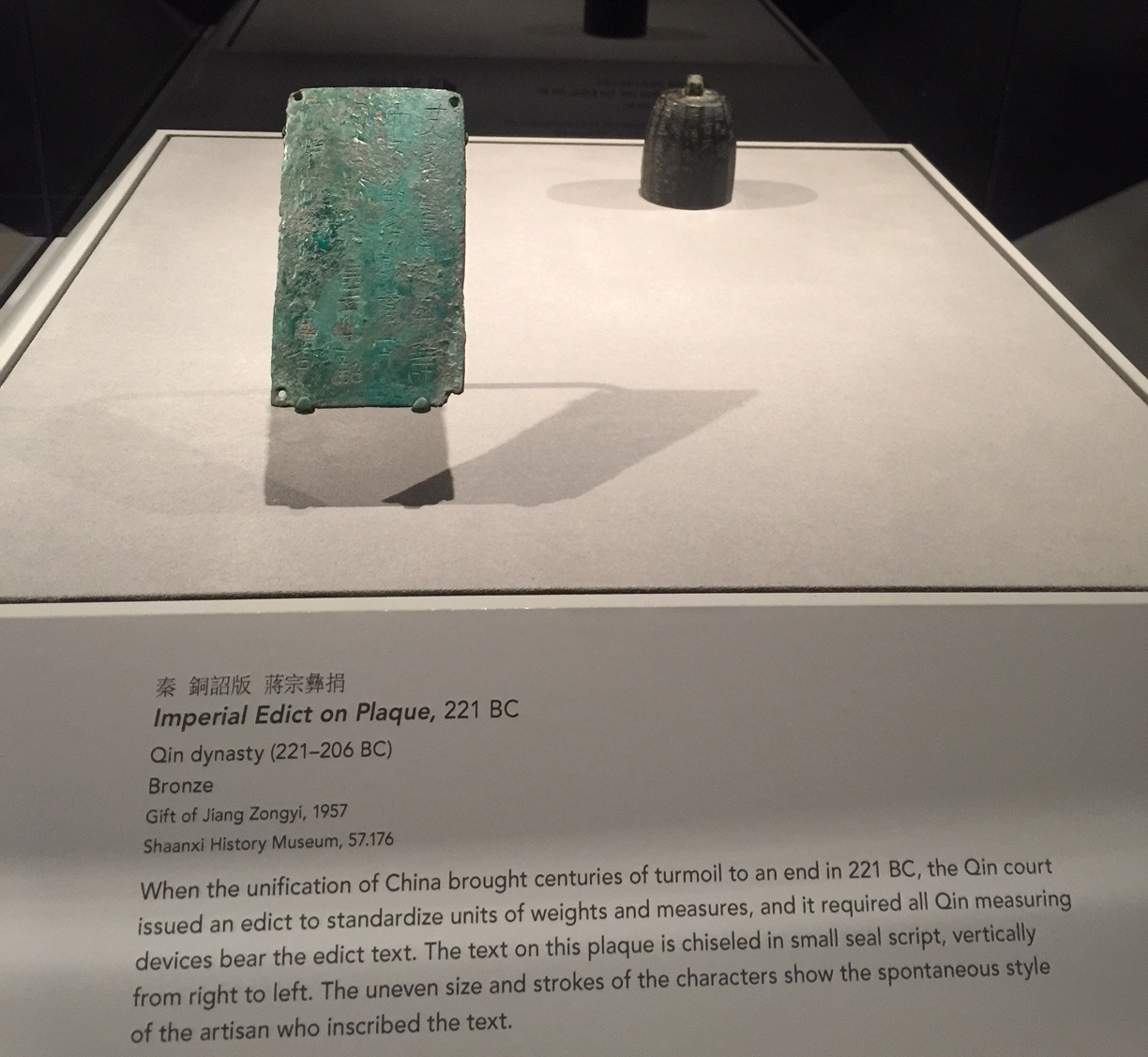
On Wednesday I visited the Terracotta Warriors exhibit on show at the Victoria Museum of Fine Arts. The visit was organized by Smithsonian Associates with members transported from the Washington, DC area to Richmond via bus. I flew in from Orlando on the morning of in order to participate.


The tour was led by an energetic and informed docent named William The combination of the quality of the pieces and his knowledge combined to make this a very satisfactory experience. The showing features a number of the Terracotta Warriors found in association with the burial mound of the first ruler of the Qin Dynasty (221 - 206 BC) and other period artifacts. I provide pictures of selected exhibit pieces below.


©Everything Else

Understanding the initial ownership paths of Vermeer's body of work: After Andrew Graham-Dixon

Andrew Graham-Dixon, acclaimed Caravaggio biographer, has recently published a book titled Vermeer: A Life Lost and Found and, while I am s...